
A good workers’ comp lag time is short, and it is short at every location. Lag time is the number of days between the injury and the day the claim is reported to your carrier or TPA. Liberty Mutual recommends reporting 80 percent of claims within 3 days. Our own standard at Amaxx is tighter: a lag of one day or less, with every injury reported within 24 hours.
The reason those targets matter is cost. In Liberty Mutual’s national account data, claims reported 8 to 14 days after the injury already cost 21 percent more and were 26 percent more likely to be litigated than claims reported within 3 days (Liberty Mutual, 2016 to 2018 data). NCCI found median claim cost about 35 percent higher for claims reported in week 3 than in week 2 (NCCI, 2015).
One caution before you set a goal. NCCI also found that claims reported the same day cost more than claims reported later in the first week, and puts that down to the most serious injuries being reported right away. So a fast report does not make a claim cheaper by the clock. What it buys you is time: care and modified duty can start while the claim is still small.
Say you have 80 claims and three locations
Say last year you had 80 claims across three locations. Take the injury date and the report date for each one from your loss run, and count how many were reported within 3 days. If you have not done this before, here is the loss run column that says more about control than your premium.
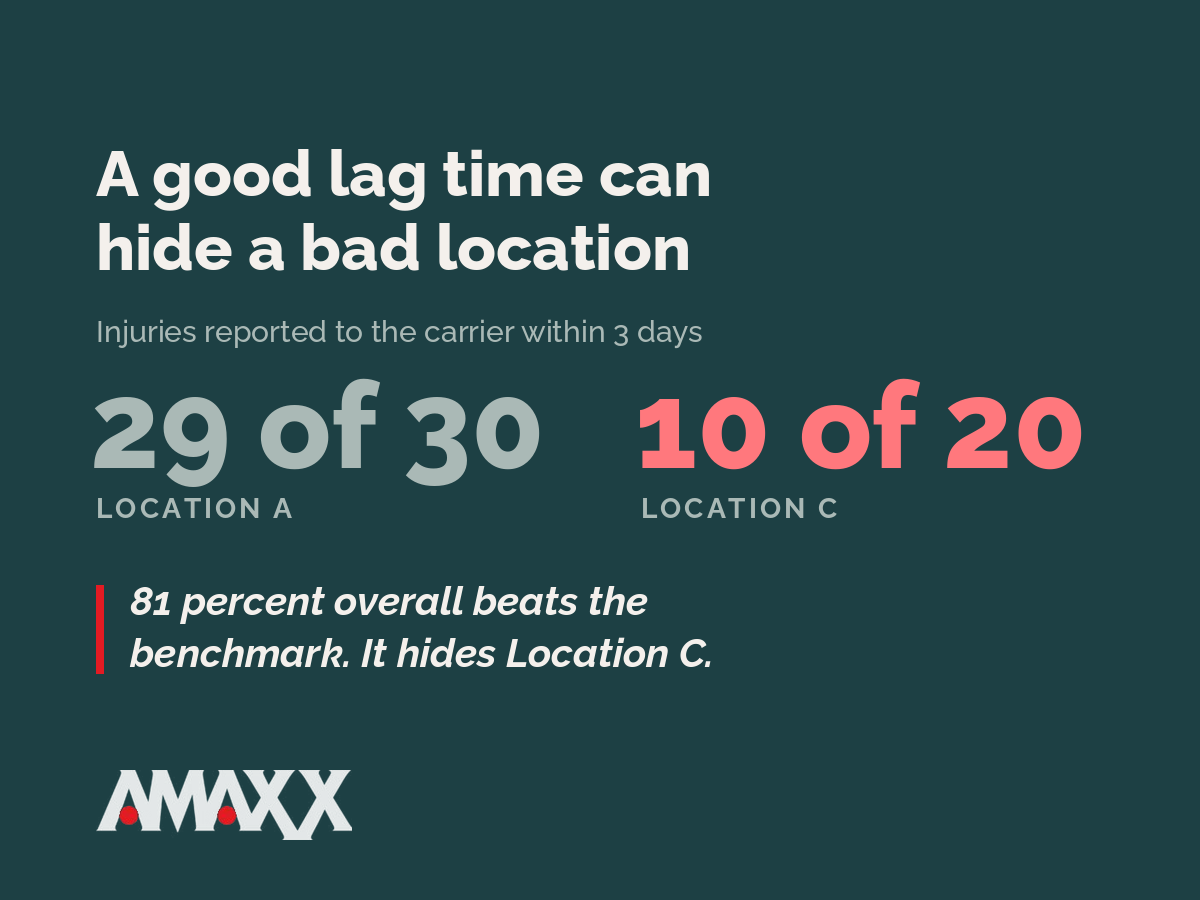
You get 65 of 80, about 81 percent. That beats Liberty Mutual’s 80 percent, and most people would stop there.
Now split it by location.
- Location A: 29 of 30 claims reported within 3 days.
- Location B: 26 of 30.
- Location C: 10 of 20.
Half of Location C’s injuries reached the carrier more than 3 days late. It had a quarter of the company’s claims and 10 of its 15 late ones. The companywide number was good. One location was not, and the total hid it.
An average lag in days can hide it as well. A few claims reported a month late will drag a good average up, and quick reports at two busy sites will pull a slow site’s number down. Look instead at the share reported within 1 day and within 3 days, location by location, and count the claims that took longer than a week.
What your lag time is actually measuring
The lag on your loss run is one number, but there are two gaps inside it. The first runs from the injury to the moment the employee tells a supervisor. The second runs from the supervisor hearing about it to the claim reaching the carrier.
The second gap is process. Does the supervisor know who to call and what goes on the first report, and is there a backup when that person is out? The first hour after an injury decides most of it.
The first gap is trust. An employee who waits a week to mention a sore back is usually deciding whether reporting is safe, whether the supervisor will believe them and whether it will cost them hours. People report quickly when they know what happens next and have seen it handled fairly for someone else. Your reporting system says more about your safety culture than your injury count does.
So when Location C’s claims come in late, skip the question of who forgot the paperwork. Ask what is different about how injuries are received there. Usually it comes down to the supervisor’s first reaction, and whether anyone calls the employee after they go home. In a lot of programs, managers never call injured employees at all.
Do your employees know what happens when they report an injury?
Free download: the 9 elements of a workers’ comp employee brochure
What a good lag time says about your program
A good companywide lag time tells you the program can work. A good lag time at every location tells you it runs the same way whichever supervisor is on shift. Those are two different findings, and most employers only ever look at the first.
What sits behind fast reporting is simple to define. Employees know what to expect, supervisors respond one way, and the report goes in the same day. The hard part is getting every location and every supervisor to do it the same way, every time.
Here is a check you can run this week. Take last year’s loss run and, for each location, count the claims reported within 1 day, within 3 days and after more than a week. If one site looks like Location C, you have found the place where your program depends on the person rather than the system.

Does it depend on which supervisor is on shift?
Twelve questions, five minutes, and a score you can take to your team.
©2008–2026 Amaxx LLC. All Rights Reserved under International Copyright Law
Do not use this information without independent verification. All state laws vary. You should consult with your insurance broker, attorney, or qualified professional.









 A Clean Safety Record Can Be the Most Dangerous Number in Your Building

