• Menu
  • Skip to main content
  • Skip to secondary navigation
  • Skip to primary sidebar
  • Skip to footer

Before Header

  • Become a Growth Partner

Amaxx Workers Comp Blog

Reduce Workers Compensation Costs By 20-50%

Header Right

  • What is IMOS?
  • Why IMOS?
  • Books
  • Software
  • Resources
    • Blog
    • Free Workers’ Comp Resource Library
    • IMOS Hub
  • Score Your WC Program

Mobile Menu

  • What is IMOS?
  • Why IMOS?
  • Books
  • Software
  • Resources
    • Blog
    • Free Workers’ Comp Resource Library
    • IMOS Hub
  • Score Your WC Program
  • Become a Growth Partner
You are here: Home / Post Injury Systems / Myth: Light Duty Rewards People for Getting Hurt

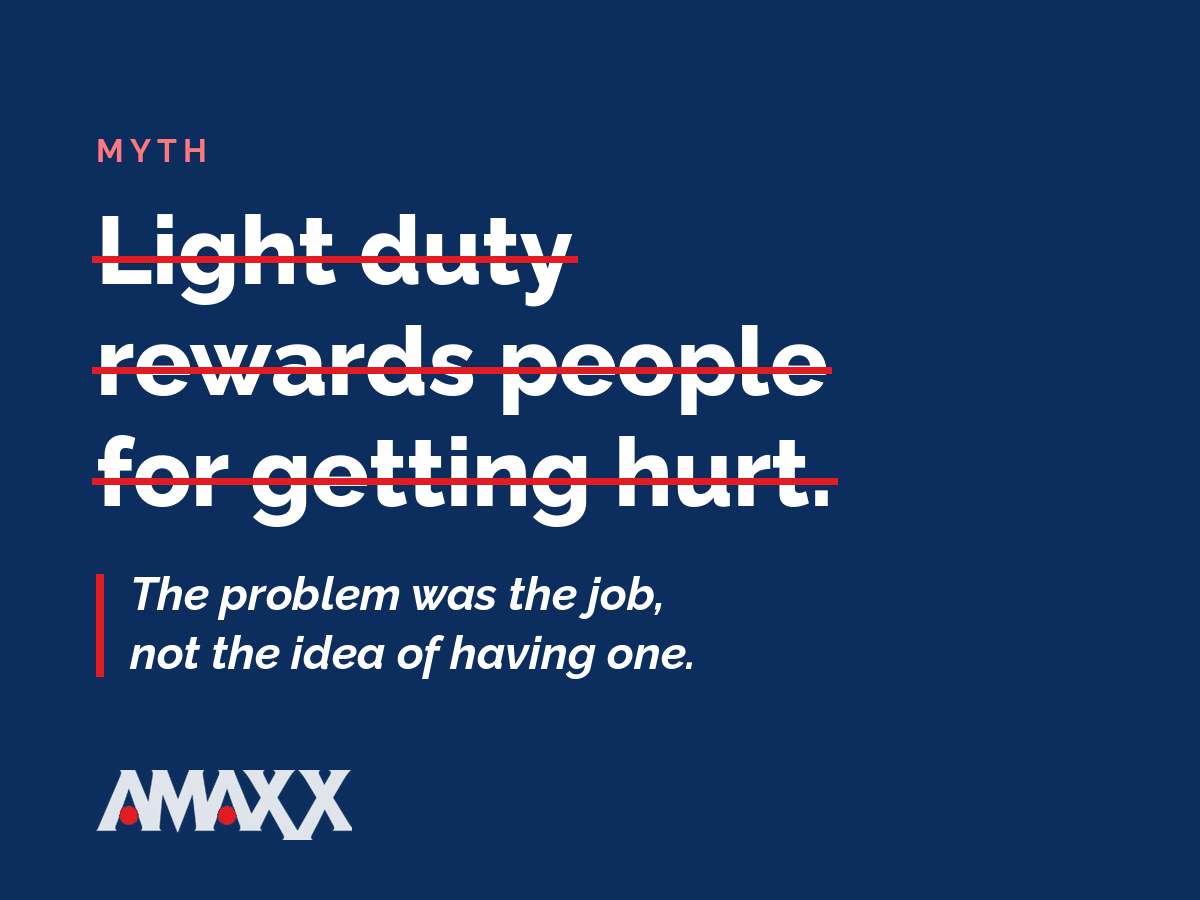
Myth: Light Duty Rewards People for Getting Hurt

November 5, 2026 By //  by Michael B. Stack

“If we hand them a soft job, everybody will want to get hurt.” Most of us have heard some version of that from a plant manager or a supervisor, usually right after an injured employee came back on modified work and sat at a desk for a week.

It sounds like common sense. It is also backwards, and believing it costs more than the light duty ever would.

The belief starts with one bad assignment

Someone gets parked in a chair with nothing to do and full pay, and the crew notices. Now light duty looks like a paid break, and the manager decides the program is the problem.

What he saw was real. What he concluded was not. The problem was the job, not the idea of having one.

The research points the other way

A review of 13 higher quality studies found injured workers offered modified work returned to work about twice as often as those not offered it, and modified work programs cut lost work days in half (Krause et al., Journal of Occupational Rehabilitation, 1998). Most of those studies were observational, so the fair word is “associated with,” not “caused.” Still, nothing in them shows modified work drawing more claims.

Now think about what the alternative rewards. An employee at home with no job to come back to keeps getting a check, loses touch with the crew, and starts to wonder whether there is still a place for them. That is the claim that gets longer and more expensive, not the one where someone is back sorting parts on day two.

What actually makes light duty look like a reward

When light duty goes wrong, it is usually one of these:

  • There is no list of real modified jobs, so each supervisor makes one up on the spot.
  • The assignment has no end date and nobody reviews it.
  • The work has no value to the department, so some people read it as punishment and others as a vacation.
  • Nobody told employees, before anyone got hurt, that modified work is how the company handles every injury.

Every one of those is a design problem or a consistency problem. None of them is a reason to send people home.

If you want the basics on how an assignment is built, start with what transitional duty is and how it works.

What do your employees hear before they get hurt?

Get the 9 element blueprint for your employee injury brochure

Look at your last three injuries instead

Pull the last three injuries that came with work restrictions. For each one, ask four things. Was a modified job offered within a day or two? Was it real work? Did it have an end date? Would the answer have been the same at your other locations, or on the other shift?

If the answers depend on which supervisor was working, you have found the real problem, and it was never light duty. Light duty is simple to define and hard to execute consistently across people, departments and locations. That gap is where the reward story comes from.

Does it depend on which supervisor is on shift?

Twelve questions, five minutes, and a score you can take to your team.

Score your program in 5 minutes

Michael Stack

Michael Stack is CEO of Amaxx, which installs Injury Management Operating Systems (IMOS) for employers: one defined injury response process, clear supervisor expectations, return to work structure, a weekly scorecard and an operating rhythm that keeps it from drifting. For more than 30 years, Amaxx has helped employers take control of how injuries are handled across every supervisor, department and location.

mstack@reduceyourworkerscomp.com

©2008–2026 Amaxx LLC. All Rights Reserved under International Copyright Law

Do not use this information without independent verification. All state laws vary. You should consult with your insurance broker, attorney, or qualified professional.
Filed Under: Post Injury Systems

Related Articles

Nurse Triage: The Call You Control in the First Hour

Nurse Triage: The Call You Control in the First Hour

Nurse Triage: The Call You Control in the First Hour
The First Hour After an Injury: A Checklist Every Location Runs the Same Way

The First Hour After an Injury: A Checklist Every Location Runs the Same Way

The First Hour After an Injury: A Checklist Every Location Runs the Same Way
Your Managers Never Call Your Injured Employees.

Your Managers Never Call Your Injured Employees.

Your Managers Never Call Your Injured Employees.
2 days or 8 weeks. The difference was one supervisor's call.

What Is Transitional Duty?

What Is Transitional Duty?

The Loss Run Column That Says More About Control Than Your Premium

The Loss Run Column That Says More About Control Than Your Premium

The Screening Tool That Cut Concussion Recovery From Months to Weeks

The Screening Tool That Cut Concussion Recovery From Months to Weeks

The ROI of a Five-Minute Phone Call to an Injured Employee

The ROI of a Five-Minute Phone Call to an Injured Employee

Why Your DART Rate May Be a Bigger Problem Than Your TRIR

Why Your DART Rate May Be a Bigger Problem Than Your TRIR

Your Workers’ Comp Results Depend on This One Role

Your Workers’ Comp Results Depend on This One Role

Why Confusion Is Costing You More in Workers’ Comp Than You Think

Why Confusion Is Costing You More in Workers’ Comp Than You Think

Why Good Intentions Fail in Workers’ Comp Programs

Why Good Intentions Fail in Workers’ Comp Programs

The Trust Gap in Workers’ Comp: Why Employees Don’t Believe the System Works

The Trust Gap in Workers’ Comp: Why Employees Don’t Believe the System Works

Free Download

13 Research Studies to Prove Value of Return-to-Work Program & Gain Stakeholder Buy-In - FREE Download Click Here Now!

Score Your Program

IS YOUR INJURY RESPONSE THE SAME AT EVERY LOCATION?

Twelve questions, five minutes. See how consistently injuries are reported, followed up and returned to work across your supervisors, and where the program is leaking cost.

Score your WC program

Previous Post: «Nurse Triage: The Call You Control in the First Hour Nurse Triage: The Call You Control in the First Hour

Primary Sidebar

FREE DOWNLOAD

Step-by-Process to Master Workers' Comp in 90 Days - FREE Download Click Here Now!

Share Us

Catastrophic and Risk Solutions, Case Management Solutions, and Specialty Networks 

WC Cost-Driver Metrics Suite

Search Our Archive

Footer

Search Our Archive

Search our continually growing archive of over 5,000 articles about Workers' Comp issues.

Quiclinks

  • Calculators
  • Terms & Abbreviations
  • Glossary of WC Premium Terms
  • WC Resources
  • Best Practices
  • Industries
  • Return-to-Work Essentials

RSS feed: Recent Blog Posts Recent Blog Posts

  • Nurse Triage: The Call You Control in the First Hour
  • A 0.87 Mod Can Still Hide $305,000 of Controllable Premium
  • The First Hour After an Injury: A Checklist Every Location Runs the Same Way
SUBSCRIBE TO OUR FEE NEWSLETTER
Let Us Help You Stomp Down the High Cost of Workers' Comp!
Top of Page ↑
  • Home
  • Training Center
  • Search
  • Membership
  • Products
  • Blog
  • About
  • Contact
  • Subscribe
  • Login
  • Privacy
Copyright © 2026 Amaxx, LLC. All Rights Reserved. · Privacy Policy / Legal Notice