
Workers’ comp nurse triage is a phone call made right after a workplace injury. A nurse asks a set of medical questions and recommends a level of care: first aid and self care at work, a clinic visit, or emergency care. That is the decision it makes. It does not record the case on your OSHA log, it does not decide whether there is a workers’ comp claim, and it does not get anyone back to work. Those stay with you, and so does the call itself.
The nurse decides where the employee goes next
A good triage call gets an injured employee to the right level of care quickly, with someone qualified asking the questions instead of a supervisor guessing. If the employee needs treatment, the answer is treatment. Triage is not a gate for keeping people away from a doctor, and it should never be run as one.
The OSHA rules show why the level of care matters to you. OSHA’s first aid list is a closed list: 14 items, and 29 CFR 1904.7(b)(5)(iii) says it is complete. Care that stays inside it does not by itself make a case recordable. First aid is first aid whoever gives it, a nurse or physician included (29 CFR 1904.7(b)(5)(iv)).
A clinic visit is not automatically treatment either. A visit to a physician or licensed health care professional solely for observation or counseling is not medical treatment under OSHA’s recordkeeping rule, and neither are diagnostic procedures such as x rays and blood tests (29 CFR 1904.7(b)(5)(i)). The word “solely” carries that rule. If the clinician recommends treatment beyond first aid, the case is recordable even if the employee declines it (29 CFR 1904.7(b)(5)(v)).
So the outcome depends on the care given and what a clinician recommends, not on the phone call.
Triage can’t do the rest of the first hour
The nurse does not diagnose, and the nurse does not decide recordability. You keep the log. Whether a claim exists is set by state law and your carrier, not by the call.
The bigger gap is everything around the call. Triage does not tell the supervisor what to do next, call the employee the next morning, line up a modified job, or tell you where the person went and when the next appointment is. That is the rest of the first hour after an injury, and it belongs to you.
It is also worth knowing what a call creates on the other end. Ask your carrier or vendor whether a call to the line is logged as a record only or opens a claim. The answer varies by arrangement, and you want it before the number goes up on every wall. We put the rest of those questions in what to ask before signing with a triage vendor.
Say you have four locations and 60 injuries a year
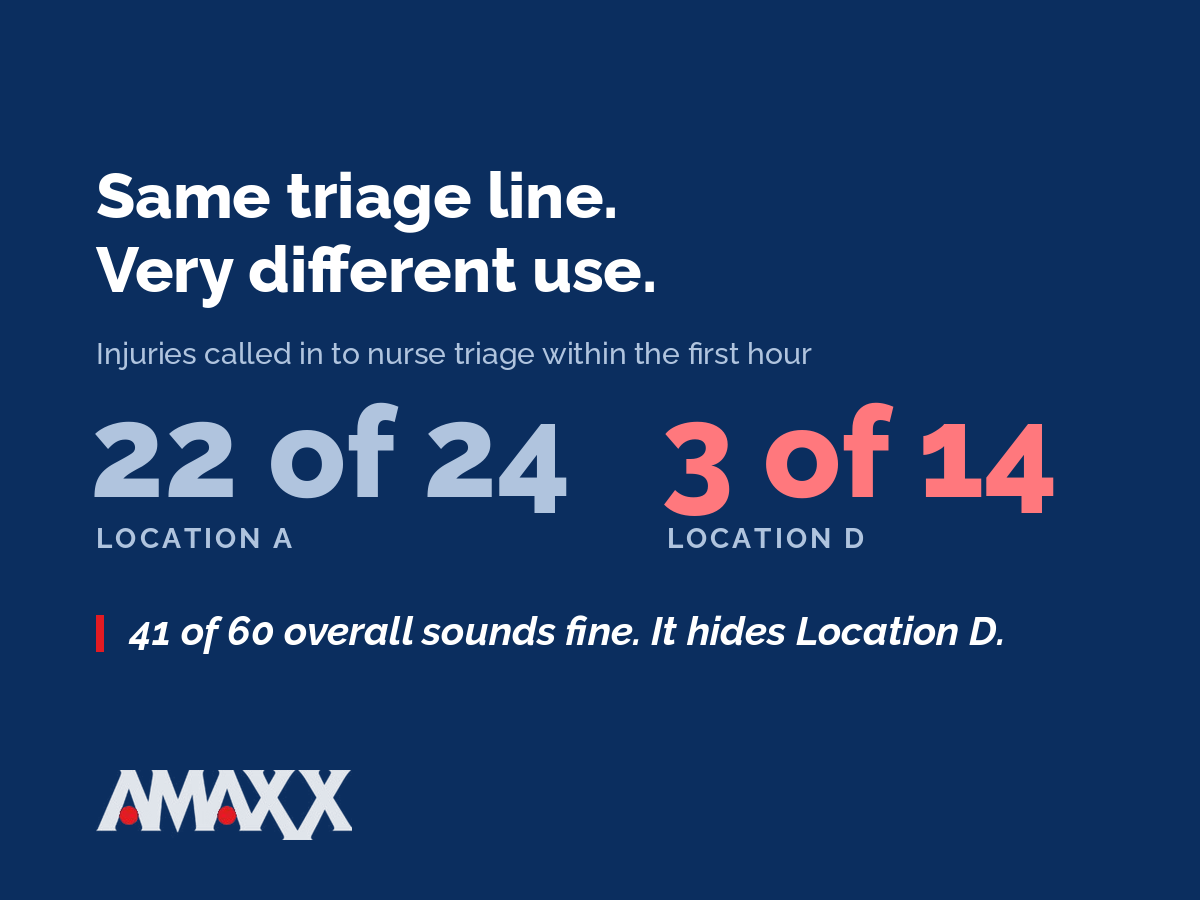
Every location has the triage number posted. Pull last year’s 60 injuries and ask one question of each: was the line called within the hour?
- Location A: 22 of 24
- Location B: 9 of 12
- Location C: 7 of 10
- Location D: 3 of 14
That is 41 of 60 overall, which sounds fine in a leadership meeting. Location D tells a different story. Same vendor, same number on the wall, and most of its injured employees never reached the nurse. The difference is who is on shift. When you ask why, the answer is usually a supervisor, not a policy: one drives people to urgent care himself, another waits to see if it gets better.
Now ask a second question of the 41 calls. What was recommended, where did the person go, and who followed up? If that takes a week of emails to answer, you have a triage service. You do not have visibility into your employees’ care.
Is your program actually under control?
What the answer says about your program
Nurse triage covers one decision in the first hour. Who makes the call, how fast it happens, who gets told and what the employee hears next are decisions you either own or leave to whoever is on shift. Defining them is simple. Running them the same way across people, departments and locations is the hard part, and it already shows in numbers you have, like the lag column on your loss run.
Check these this week:
- How many injuries last month went through triage, counted by location.
- For each one, what was recommended and where the employee went.
- Who called the employee the next day, and whether that step is written down anywhere.
If any of those takes more than an afternoon to answer, the call is happening on its own, and nobody owns what comes after it.
Is your program actually under control?
Twelve questions, five minutes, and a score you can take to your team.

©2008–2026 Amaxx LLC. All Rights Reserved under International Copyright Law
Do not use this information without independent verification. All state laws vary. You should consult with your insurance broker, attorney, or qualified professional.








 A 0.87 Mod Can Still Hide $305,000 of Controllable Premium

