You lower your experience mod by having fewer claims that count against it and by keeping the ones you do have small. The mod compares your actual losses with what is expected for an employer of your size in your industry, so the levers are how often people get hurt, how much each injury ends up costing, and whether the numbers on your rating worksheet are right. You cannot change the claims already in your mod. You can change how the next one is handled, and that is where almost all of the controllable cost sits.
What a mod point is worth, in dollars
Say you have $8 million in payroll and an average rate of $2.50 per $100 of payroll. These are round numbers, not any one employer’s. Before the mod, that is $200,000 of premium.
- At a 1.20 mod, you pay $240,000.
- At a 0.75 mod, you pay $150,000.
Same payroll, same work, same rate, and a $90,000 difference every year. Because the mod is built from several years of losses, a bad year does not cost you once. It keeps showing up at renewal after renewal, which is why a mod is a scorecard, not a strategy. By the time it moves, the injuries behind it happened a long time ago.
The claim that does the most damage is not the biggest one
Most of the mod is driven by how many claims you have and what kind they are, not by the single large loss everyone remembers. The rating formula counts the first dollars of every claim most heavily, so a steady run of ordinary injuries can move the mod more than one serious one.
The kind of claim matters too. Where NCCI’s experience rating adjustment applies, which is most states, a medical only claim counts at 30 percent of its value in the experience mod, a 70 percent reduction (NCCI, ABCs of Experience Rating, 2025). On that same payroll, a $4,000 medical only claim enters the mod at $1,200.
Now let that same injury turn into lost time. The reduction is gone, the full value counts, and the value itself is far higher once wage replacement starts. Roughly 70 percent of workers’ comp claims are medical only, averaging about $1,600 against about $40,200 for a claim with lost time (NCCI, accident year 2021). The move from one column to the other is the mod event most worth preventing, and the handling in the first days is the part you control.
Where the controllable part lives
So the practical answer to how you lower your mod comes down to a short list of things that happen before the claim is ever priced:
- Every injury reported fast, so care starts and the claim is managed from day one.
- Someone in contact with the injured employee, so a medical only claim does not drift into lost time because nobody called.
- Modified work ready, so an employee who can do some of the job comes back to it instead of staying home.
- Your rating worksheet checked every year for closed claims still carrying reserves and claims recorded in the wrong category.
None of that is a secret. The employers whose mods actually come down are not the ones who know the list. They are the ones who do it the same way at every location, on every claim, including the ones that happen on a night shift with a new supervisor.
What your mod says about control
If the only time anyone in your company looks at the mod is at renewal, you are reading a grade on how injuries were handled years ago, and you have no way to tell whether this year is better. That is how an employer comes to believe its costs are just what they are.
An employer in control can answer a few questions at any point in the month. How many claims are open? How many started medical only and turned into lost time, and why? Which locations are reporting late? A good mod you cannot explain is as much a risk as a bad one, because nothing tells you when it is about to turn.
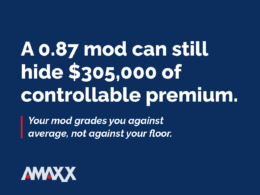
If you want to see what your own numbers would show, start by working out how much of your premium is controllable. The sheet below walks through your minimum mod and the premium you could still take out.
What would your loss runs show?

Contact: mstack@reduceyourworkerscomp.com
©2008–2026 Amaxx LLC. All Rights Reserved under International Copyright Law
Do not use this information without independent verification. All state laws vary. You should consult with your insurance broker, attorney, or qualified professional.