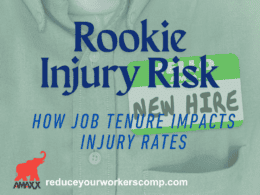
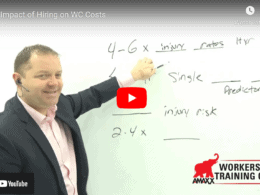
Sound familiar? You’re not alone. New hires are 4 to 6 times more likely to get injured in their first month than employees who’ve been on the job for a year or more.
Click Link to Access Free PDF Download
“4-Step Sequence For Effective Employee Screening, Hiring, & Placement”
This startling statistic isn’t just an HR problem—it’s a safety crisis hiding in plain sight. And for employers, it’s a costly one.
The New Hire Injury Spike: By the Numbers
Multiple studies back up what many employers already suspect:
-
35% of all workplace injuries happen in the first year.
-
New hires in the first month are at 4–6 times greater risk of injury than longer-term employees.
-
First-year injuries often result in 2–4 times higher claim costs, as employees lack familiarity and confidence.
Certain industries feel this pain more acutely:
-
52% of restaurant industry claims occur in year one.
-
44% of construction injuries hit first-year workers.
-
Transportation and warehousing see similarly high rates.
These figures translate to millions of lost workdays and thousands of dollars per claim—all tied to employees who barely had time to unpack their toolboxes.
So why are new hires so vulnerable?
Why the First Month is So Dangerous
Several factors converge to make those first days on the job uniquely hazardous:
1. Lack of Familiarity
New hires simply don’t know the ropes. They’re unfamiliar with:
-
Equipment and tools
-
Layouts of facilities
-
Company-specific safety protocols
-
Reporting procedures for hazards
A seasoned employee instinctively knows how to handle a jammed machine or navigate a crowded warehouse aisle. A new hire might panic—or guess wrong.
2. Rushed or Incomplete Training
Understaffing and tight deadlines often lead employers to rush onboarding. The mindset is:
“We’ll train them on the fly.”
Unfortunately, training “on the fly” doesn’t stick—especially under pressure. Workers thrown into the deep end without proper instruction are more prone to mistakes that cause injuries.
3. Physical Readiness Gaps
New hires may lack the physical conditioning or technique needed for demanding roles:
-
Lifting heavy loads improperly
-
Overexerting muscles not used to repetitive tasks
-
Straining joints and backs while trying to “keep up”
4. Psychological Pressures
A new worker often wants to impress their boss and coworkers. They’re more likely to:
-
Work too quickly
-
Avoid speaking up about hazards
-
Take shortcuts to appear capable
This combination of inexperience and eagerness to please creates a perfect storm for injury.
The Cost of Ignoring the Problem
Besides human suffering, new hire injuries are financially devastating:
-
Medical costs
-
Indemnity payments for lost time
-
Overtime to cover absent workers
-
Higher insurance premiums
And that’s before factoring in indirect costs:
-
Lower morale among existing staff
-
Delays in production
-
Reputational damage with customers or clients
All because someone wasn’t properly prepared for the job.
How Employers Can Break the Cycle
Here’s the good news: you can dramatically reduce new hire injuries by changing how you onboard and support employees in their first weeks.
Let’s turn “trial by fire” into training for success.
1. Gradual Exposure to Hazards
Instead of dropping new hires into the full workload:
-
Start with lighter tasks or partial shifts.
-
Allow them to build stamina and technique.
-
Increase complexity gradually over several weeks.
For example:
-
Day 1-5: Observe processes and handle light tasks.
-
Week 2-3: Work under supervision on moderate tasks.
-
Week 4+: Take on full responsibilities.
This reduces physical strain and gives workers time to learn safely.
2. Structured, Job-Specific Training
Generic safety videos won’t cut it. Instead:
-
Provide hands-on training for the specific equipment and tasks in the role.
-
Demonstrate correct body mechanics for lifting, pushing, and repetitive motions.
-
Cover emergency procedures in detail.
-
Reinforce training through quizzes or practical demonstrations.
Training should be ongoing, not one-and-done. Repetition cements safe habits.
3. Assign Mentors
A seasoned mentor offers:
-
Real-time guidance
-
Feedback on technique and safety practices
-
Someone new hires trust to answer questions
Mentors help bridge the gap between theory and practice. They also spot early signs of fatigue or confusion before an injury occurs.
4. Foster Open Communication
Make it safe for new hires to say:
-
“I don’t know how to do this.”
-
“This feels too heavy.”
-
“Something seems unsafe.”
Leaders should encourage questions and praise workers who raise concerns.
5. Monitor and Follow Up
Schedule check-ins at:
-
End of week one
-
Day 30
-
Day 60
Ask new hires:
-
How comfortable they feel in their tasks
-
Whether they understand safety protocols
-
If they’ve experienced any soreness or near misses
Follow-ups allow managers to correct unsafe habits before they become injuries.
The ROI of Protecting New Hires
Investing in a safer onboarding process pays off quickly:
-
Fewer injuries
-
Lower claims costs
-
Less disruption to operations
-
Higher morale and retention
Companies who implement gradual onboarding, mentorship, and structured training consistently see significant drops in first-year injury rates.
Your first 30 days with a new hire set the tone for years of safety—or months of chaos.
Final Thought: From Trial by Fire to Safety First
The idea that new hires need to “prove themselves” under intense pressure is outdated—and dangerous.
If your injury reports are stacked with first-year claims, look closely at your onboarding. With the right systems, you can replace trial by fire with training, support, and safety.
Because in the end, keeping your people safe isn’t just the right thing to do—it’s the smartest business decision you’ll ever make.
 Michael Stack, CEO of Amaxx LLC, is an expert in workers’ compensation cost containment systems and provides education, training, and consulting to help employers reduce their workers’ compensation costs by 20% to 50%. He is co-author of the #1 selling comprehensive training guide “Your Ultimate Guide to Mastering Workers’ Comp Costs: Reduce Costs 20% to 50%.” Stack is the creator of Injury Management Results (IMR) software and founder of Amaxx Workers’ Comp Training Center. WC Mastery Training teaching injury management best practices such as return to work, communication, claims best practices, medical management, and working with vendors. IMR software simplifies the implementation of these best practices for employers and ties results to a Critical Metrics Dashboard.
Contact: mstack@reduceyourworkerscomp.com.
Workers’ Comp Roundup Blog: https://blog.reduceyourworkerscomp.com/
Injury Management Results (IMR) Software: https://imrsoftware.com/
©2025 Amaxx LLC. All rights reserved under International Copyright Law.
Do not use this information without independent verification. All state laws vary. You should consult with your insurance broker, attorney, or qualified professional.