-
The number of claims, and
-
The cost per claim.
Every other data point, strategy, or initiative ultimately supports one of these two forces. Understanding them — and managing them intentionally — is how organizations gain true control over workers’ compensation outcomes.
The Power of Simplicity
Workers’ comp programs often get lost in a sea of metrics. Lag time, litigation rate, return-to-work ratios, lost time claims, large losses — they all matter, but they’re not equal. Each one is a driver, not the destination.
Click Link to Access Free PDF Download
When viewed through the right lens, all these metrics roll up into two categories:
-
How often injuries occur (frequency)
-
How expensive each injury becomes (severity)
This perspective brings clarity and control. Instead of reacting to every report, you can target the true source of the cost problem — whether it’s happening before the injury (safety and prevention) or after the injury (claims management and recovery).
Lever One: The Number of Claims
The first cost driver is simple: every claim you prevent is a claim you don’t have to manage.
Claim frequency reflects the success of your safety initiatives, employee training, and organizational culture. It’s a direct measure of how effectively your company is preventing incidents in the first place.
Common ways to measure it:
-
Claims Rate = (Number of Claims × 200,000) ÷ Total Hours Worked
-
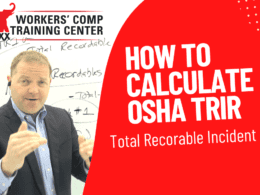
TRIR (Total Recordable Incident Rate) – OSHA’s standardized benchmark for comparing performance across industries.
Both formulas adjust for company size, making it possible to compare apples to apples across years, divisions, or locations.
When the number of claims rises faster than your workforce grows, that’s an early warning signal — your safety systems or culture need attention. Conversely, when claims fall even as the workforce expands, you’re seeing proof that prevention strategies are working.
Lever Two: The Cost per Claim
The second lever reflects the quality of your injury management practices. Once an injury occurs, the question is no longer if there will be cost — it’s how much.
Average cost per claim depends on controllable factors:
-
Lag time (how quickly the claim is reported)
-
Return-to-work rate (how soon the employee is back on the job)
-
Medical coordination (appropriate care and communication)
-
Litigation rate and large-loss prevention
These are the points of influence where proactive management makes the difference between a $3,000 medical-only claim and a $40,000 lost-time claim.
For example, shortening average lag time from 10 days to 2 days reduces the risk of litigation and long-term disability. Expanding modified duty options lowers indemnity costs and keeps employees engaged. Each improvement in process directly lowers cost per claim — the second lever of total cost control.
How the Two Levers Work Together
Imagine your total workers’ comp cost as a simple equation:
Total Cost = Number of Claims × Average Cost per Claim
Reduce either variable, and total cost declines.
Reduce both, and results compound exponentially.
-
If your claim count drops by 20%, and your average cost per claim drops by 20%, your total cost falls by more than a third.
-
That’s the power of alignment between safety (claim frequency) and injury management (claim severity).
These two forces are the “two sides of the same coin.” Safety prevents injuries; claims management controls what happens when injuries occur. Together, they create measurable, sustainable reductions in total cost.
Using Data to Target the Right Lever
The key to intelligent cost control is identifying which lever needs your focus right now.
Ask two questions:
-
Are we having too many claims?
-
Are our claims too expensive?
If claim count is high, your problem is prevention. Focus on safety leadership, near-miss reporting, and culture.
If claim costs are high, your problem is management. Focus on faster reporting, medical coordination, and return-to-work.
By viewing data through these two lenses, you eliminate guesswork and replace it with a clear, actionable plan.
The Value of Balance
Many organizations lean heavily on one side. Some invest heavily in safety but neglect post-injury management, leading to expensive claims when incidents occur. Others perfect return-to-work programs but ignore leading indicators that prevent injuries altogether.
The most successful programs balance both. They build a safety culture that minimizes claims, and a responsive management system that minimizes costs when injuries happen.
That’s what true cost control looks like — not endless spreadsheets, but clarity about which lever you’re pulling, why, and what result it’s driving.
FREE DOWNLOAD: “5 Critical Metrics To Measure Workers’ Comp Success”
Bringing It All Together
These two levers form the foundation of the Workers’ Comp Cost Driver Matrix — the framework for transforming raw data into a meaningful story.
-
Lever 1: Number of Claims – Safety and prevention
-
Lever 2: Cost per Claim – Injury management and recovery
Every other metric you track should support one of these. When you understand how to influence each lever, you can connect every data point to a financial outcome and a management decision.
In the final part of this series, we’ll explore how to take these insights and turn your data into a narrative that drives change — one that inspires action, wins executive buy-in, and positions workers’ comp as a controllable, measurable profit driver for your organization.

Contact: mstack@reduceyourworkerscomp.com.
Workers’ Comp Roundup Blog: https://blog.reduceyourworkerscomp.com/
Injury Management Results (IMR) Software: https://imrsoftware.com/
©2025 Amaxx LLC. All rights reserved under International Copyright Law.
Do not use this information without independent verification. All state laws vary. You should consult with your insurance broker, attorney, or qualified professional.
FREE DOWNLOAD: “5 Critical Metrics To Measure Workers’ Comp Success”