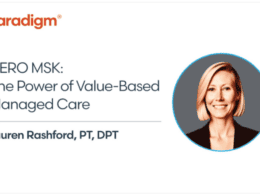
This year, I made a point to attend their Lunch and Learn session, “What is a Bundle, y’all?” led by Cody Marks, Lauren Rashford, and Elizabeth Ulloa Lowry to hear how the program performed in its first full year.
When Paradigm first launched the HERO MSK program, the idea of a true value-based model for musculoskeletal injuries, complete with guaranteed outcomes and a fixed price, stood out as ambitious. After hearing the team share results and insights this year, it is clear the concept has moved well beyond theory. The program is reshaping how MSK claims are managed. As Lauren Rashford noted, “HERO MSK represents the next generation of value-based care in workers’ compensation—delivering results that prove great care and financial performance go hand in hand.”
Their message throughout the conference was consistent. Workers’ compensation has operated with fragmented systems and misaligned incentives for far too long. Bundled models and value based care are no longer emerging ideas. They are actively changing recovery trajectories for injured workers.
Why MSK Needed a Different Approach
MSK injuries sit in a tricky space for employers and payers. They’re everywhere, they’re expensive, and they often drag on.
Traditional fee-for-service models pay for activity and volume, not outcomes. That can unintentionally reward more imaging, more visits, more procedures, without necessarily delivering faster recovery, better function, or earlier return to work.
Cody Marks emphasized this problem clearly: we’re still operating in a system designed around disconnected services instead of aligned, predictable care. The result is inefficiency, risk, and a lack of accountability for functional outcomes.
Layer on top of that the human complexity of an MSK injury:
- Pain and fear about work, identity, and income
- Unaddressed depression or anxiety
- Past or current substance use
- Medical comorbidities like tobacco use, diabetes, or elevated BMI
When those factors go undiscovered or unmanaged, claims don’t just get more expensive. They stall. They litigate. They erode trust. A telling stat discussed during the session was that disengagement is one of the strongest predictors of attorney involvement.
The HERO MSK Model: Value Based for Non-Catastrophic Injuries
HERO MSK extends the fixed price, guaranteed outcome structure that has anchored Paradigm’s catastrophic program for more than thirty years. It brings that discipline to one of the most common and unpredictable categories in workers’ compensation: musculoskeletal injuries. Rather than paying for each visit or procedure, the employer purchases the outcome, which shifts incentives toward recovery instead of volume.
At the Lunch and Learn, Cody Marks, Lauren Rashford, and Elizabeth Lowry explained how the program blends value-based care with a true bundled model. The surgical bundle is central to this design.
The surgical bundle:
- Includes all medical costs tied to the episode
- Transfers full medical risk to Paradigm
- Uses specialty networks aligned to outcome based reimbursement
- Stabilizes cost at the outset rather than allowing it to escalate
The full HERO MSK model builds on this structure with a coordinated, whole person approach.
The broader program includes:
- Guaranteed outcomes for MSK cases
- A fixed price structure for the entire episode
- Comprehensive risk stratification across medical, psychosocial, and behavioral factors
- High performing specialty networks that share risk
- Field case management when needed
- Dedicated clinical oversight from injury through recovery
Given that the average MSK surgical patient presents with two comorbidities, combining risk transfer with whole person stabilization creates advantages for everyone. Employers gain predictability, providers gain clear targets, and injured workers gain a coordinated path to faster and safer recovery.
Patient Engagement: “My Nurse in My Pocket”
One of the most impressive statistics from the HERO MSK program could be its engagement numbers, and their impact on litigation, indemnity, and claim duration.
Paradigm reported:
- 94.6% engagement inside HERO MSK
- 13.6% engagement outside the program
This difference appears to be one of the clearest predictors of better outcomes.
Digital check-ins, secure text messaging, and phone outreach give injured workers constant access to support. Elizabeth Lowry noted that one injured worker described the experience as having “my nurse in my pocket,” a line that captures how personal and accessible the program feels to those recovering.
Because individuals are far more likely to share honest information digitally, the care team gains earlier insight into pain levels, emotional strain, concerns about recovery, and potential opioid risk. With the digital platform absorbing administrative tasks, nurses are free to do what they do best: provide clinical care, coordination, and reassurance.
Engagement Impact on Litigation, Indemnity, and Claim Duration: The Hidden ROI
My biggest takeaway from the session was that engagement numbers are not just impressive statistics, they are the engine behind the program’s financial and functional results.
When injured workers are actively engaged and barriers are identified early, the entire claim behaves differently. Because of this, the most meaningful financial savings in MSK are not in medical line items.
Paradigm shared early impact metrics:
- Less than 6% attorney involvement, compared to 35–40% in typical MSK claims
- Shorter claim duration due to earlier recovery and fewer delays
With higher engagement and earlier risk mitigation, injured workers return to work sooner, avoid unnecessary procedures, and experience fewer emotional or behavioral barriers that typically stall claims.
Why HERO MSK Matters and What’s Ahead
Sitting in the session this year, what struck me most was how much clarity and structure HERO MSK brings to an injury category that has traditionally been unpredictable. It offers employers and carriers a way to trade variability for a coordinated approach that genuinely supports the injured worker from start to finish.
The benefits Paradigm shared were meaningful. They reported:
- Defined pricing and predictable costs
- Stronger worker engagement and trust
- Dramatic reduction in attorney involvement
- Faster recovery timelines
- Better clinical and functional outcomes
Hearing those results in the context of real cases made the value of the model even more apparent. They also reinforced a point Rashford emphasized during the session: “We’ve shown that better outcomes don’t have to cost more. Our partners are part of a growing movement to redefine how MSK care is delivered—through value, data, and shared accountability.”
Looking ahead, it is clear that HERO MSK is part of a broader shift in the industry. Workers’ compensation is beginning to adopt lessons long used in commercial healthcare, where aligned incentives and early intervention consistently lead to better outcomes. Programs like this show what is possible when the system is designed around recovery instead of transactions and when coordination replaces fragmentation.
As Paradigm’s leaders emphasized at National Comp, bundles and value based care are not buzzwords. They are becoming the foundation for the next era of MSK management, an era where engagement drives recovery and predictable outcomes replace uncertainty.

Contact: mstack@reduceyourworkerscomp.com.
Workers’ Comp Roundup Blog: https://blog.reduceyourworkerscomp.com/
Injury Management Results (IMR) Software: https://imrsoftware.com/
©2025 Amaxx LLC. All rights reserved under International Copyright Law.
Do not use this information without independent verification. All state laws vary. You should consult with your insurance broker, attorney, or qualified professional.