Find Out About Quality Claims Handling Services

MSP/MIR Compliance

Onsite Wellness Clinics, Nurse Triage, Pre-employment Screening

Physical Therapy and Rehabilitation

Federal Workers Comp Consultants and Managed Care

Buy Workers Compensation Business Insurance

Workers Compensation and Occupational Medicine Conference


Buy through Advisen

Buy through RIMS (RIMS Members)


Canadian Worker Burned: New Safety Measures Put in Place


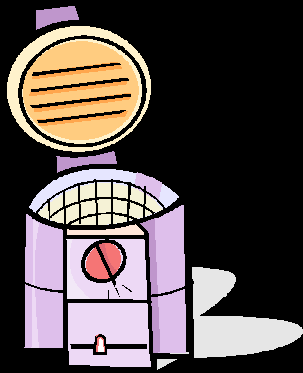
A worker who sustained burn injuries while changing grease in a fryer at a plant in New Annan, Prince Edward Island, has prompted the implementation of several safety measures, according to a report from the Canadian OH&S News.
 
 
At approximately 2 a.m. June 21, a worker at Cavendish Farms, a processor of frozen potato products, was changing grease in a fryer by operating a series of valves. When the grease went into one of the filtering systems, water that was somehow left in the system from a previous cleaning caused the grease to overflow, explained Bill Reid, director of the Occupational Health and Safety Division for the Workers Compensation Board of Prince Edward Island in Charlottetown.(WCxKit)
 
 
Board officials investigated the incident and issued a stop-work order on the equipment. Within the day, the employer implemented engineering controls to relocate the control valves to a remote area so that workers do not have to go under the equipment.
 
 
A barrier has also been installed over the valve to prevent grease overflow and the company also came up with a new procedure for the cleaning process to ensure no water could be left in the filtering system. The system is also expected to be replaced this fall.(WCxKit)
 
 
The stop-work order was lifted the day after these engineering and administrative controls were put in place, Reid says.

 
Author Robert Elliott, executive vice president, Amaxx Risk Solutions, Inc. has worked successfully for 20 years with many industries to reduce Workers Compensation costs, including airlines, healthcare, printing/publishing, pharmaceuticals, retail, hospitality and manufacturing. See www.LowerWC.com for more information. Contact: Info@ReduceYourWorkersComp.com.


LEARN MORE IN OUR BOOK: www.WCManual.com

 
Do not use this information without independent verification. All state laws vary. You should consult with your insurance broker or agent about workers comp issues.
 
©2011 Amaxx Risk Solutions, Inc. All rights reserved under International Copyright Law. If you would like permission to reprint this material, contact Info@ReduceYourWorkersComp.com.
Posted in Canada Workers Comp, Safety and Loss Control |


Comments Off

OSHA Renews Alliance with Scaffold Industry Association


The Department of Labor's Occupational Safety and Health Administration (OSHA) recently renewed its alliance with the Scaffold Industry Association, Inc. (SIA), aiming to protect the safety and health of those working on scaffolds from falls and other deadly hazards, according to information provided by the agency.
 
 
Since the nationwide alliance was signed in 2008; OSHA and SIA have developed safety materials on transport platforms and mast-climbing work platforms relating to scaffold and fall hazards, as well as applicable American National Safety Institute (ANSI) consensus standards. Several of these products have been translated into Spanish and Portuguese.(WCxKit)
 
 
Goals of the renewed alliance include increasing awareness of OSHA's rulemaking and enforcement initiatives, developing new effective training and education programs, and conducting outreach and communication activities on workers' rights and employers' responsibilities. The organizations will continue to emphasize scaffold safety, including issues related to mast climbing scaffolding, suspended scaffolding, and aerial lift equipment.
 
 
SIA is a national trade organization founded in 1972, which represents the scaffold, aerial lift and access industry. SIA promotes safety in these areas by developing educational and training courses, audiovisual programs, and codes of safe practices. It has more than 1,000 member companies including aerial platform dealers and distributors; scaffold and shoring erectors and renters; plank and platform manufacturers and distributors; safety and engineering consultants; and government officials.
 
 
Through the alliance Program, OSHA works with groups committed to worker safety and health to prevent workplace fatalities, injuries, and illnesses. These groups include unions, consulates, trade or professional organizations; faith- and community-based organizations; and business and educational institutions.(WCxKit)
 

OSHA and the groups work together to develop compliance-assistance tools and resources, share information with workers and employers, and educate workers and employers about their rights and responsibilities. Alliance program participants do not receive exemptions from OSHA programmed inspections.

 
Author Robert Elliott, executive vice president, Amaxx Risks Solutions, Inc. has worked successfully for 20 years with many industries to reduce Workers Compensation costs, including airlines, healthcare, printing/publishing, pharmaceuticals, retail, hospitality and manufacturing. See www.LowerWC.com for more information. Contact: Info@ReduceYourWorkersComp.com.

 
Do not use this information without independent verification. All state laws vary. You should consult with your insurance broker or agent about workers comp issues.
 
©2011 Amaxx Risk Solutions, Inc. All rights reserved under International Copyright Law. If you would like permission to reprint this material, contact Info@ReduceYourWorkersComp.com.
Posted in Communication with Employees, Management Commitment, Risk Management, Safety and Loss Control |


Comments Off

Top 5 Workplace Injuries and How to Prevent Them


Every year thousands of employees are injured in the course and scope of their employment. The goal of our blog is to help find ways to reduce those numbers. The majority of these injuries are preventable. There are a lot of resources your carrier can provide to help you reduce your claims dollars spent on workers compensation medical expenses and lost time wages from work due to occupational injuries.
 
 
We discuss some of the more popular mechanisms of injury below:
 

1. Slip/Fall injuries

Twenty-five thousand slip-and-fall accidents occur daily in the U.S., accounting for 15 percent of all workplace injuries. It is also the leading injury to people on company premises. (WCxKit)


These types of injuries can result in fractures, dislocations, and head injuries. These types of injuries are also the most expensive to resolve, some of them resulting in the need for future medical expense and permanent occupational restrictions. Slip/fall prevention can span a variety of areas. Anti-slip coatings on floors can help, as well as strips on stairs, proper handrails on staircases, and well-placed carpets or mats by doorways.
 
 
Depending on the climate in which you are located, there are several inexpensive ways to help curb your exposure for slip/fall injuries. Make your staff wear anti-slip footwear or proper boots if they work in an outside environment. Also solicit employee feedback to find out where the problem areas are and ways to fix them. Like we always say, you would be amazed at what your employees can tell you about your workplace hazards, and the cost of obtaining that information is free.


2.  Back injuries

Back injuries account for more lost work time than any other workplace injury. Often, the source is improper lifting.
 
 
Have your employees take a course in proper lifting mechanics and proper body posturing. Look at your loss runs to see which departments have the highest injury occurrence to see what corrections need to be made. Try to palletize your inventory at floor level or just above floor level. Get workstation ergonomic specialists in to see if they are properly fitted for your employees.
 
 
Get your incoming materials to come in smaller quantities so unloading inventory is not as hazardous to your staff. See if rigid plastic tubs can be used instead of cardboard to reduce the risk of handle breaks while in the course of lifting. Again, ask your employees where the problems are and ask their ideas for making their day to day work easier to perform with less risk involved.


3.  Ergonomic/repetitive motion injuries

Musculoskeletal disorders result in over $45 billion in loss wages and productivity costs. Disorganized office workstations and poor ergonomic practices are common contributors.
 
 
You can prevent these hazards by updating your workstations. Get adjustable desks and chairs. Use ergonomic computer stations and proper computer techniques. Remember your workers are utilizing your office stations hour after hour and day after day. What starts out as a small issue can compound into a big problem, for which the only repair is surgical intervention. Your carrier will have resources to provide in how you can get your workplace evaluated for proper ergonomics and workflow.
 
 
Take the time and invest in your own company by seeing where your problem areas are and taking the time to fix them now. If you choose to ignore it, the injuries will come. Reduced productivity and lost time away from work with added medical expense will cost far more than the costs associated with having a proper ergonomic work environment for your employees.


4.  Adverse weather’s contribution to occupational injuries

It is no surprise in the winter months that injury claims increase, especially for those in the Midwest and Northeast portions of the U.S. Snow, ice, and freezing rain contribute to a lot of these injuries, and the results are falls that lead to broken bones, contusions, and potential closed head injuries. When you ask what happened, the common answer is “I couldn’t see any ice there but as soon as I stepped in the area I fell right down to the ground hard.” Black ice is becoming a major contender for the main cause of falls in early winter and early spring.
 
 
Employees coming into the building from the parking lot often drag in snow with them, which melts and becomes water on the floor, which another employee may not see and then falls in. Make sure your parking lots are properly plowed and salted at all times. Check your entrances and make sure the mats are clean and dry and in good working order. Be sure to open communication with your workers so they can report a problem in a stairwell or doorway. This can prevent a serious injury from happening.


5.  Falls from ladders or scaffolding

Falls from ladders injure of 20,000 American workers annually. Some injuries result in permanent disability and even fatalities. Safety starts before the ladder is even mounted. Teach your employees what they can do to avoid becoming injured.
 
 
Make sure your ladders are in proper working order, and that employees know how to lock them in place properly and mount them correctly to prevent the ladder from falling over. Be sure your employees know how to operate while using scaffoldings and be sure to have someone inspect them for repair before someone falls.
 
 
Since height is involved with ladders and scaffoldings, the injuries sustained are often more severe than others. Have an outside vendor come in to inspect and maintain your equipment to make sure it is in proper working order. Ask your carrier if they have resources at their disposal to recommend better, more functional ladders for the type of work you do at your facility. Stop these injuries from even happening by being proactive and safety-conscious when working at heights.(WCxKit)
 
 
In conclusion, these are the top five mechanisms of injury often seen in the workplace. Be addressing them properly and following up with ways to correct the problems, you not only make your workplace safer for your employees, but you could stop a potential severe injury from occurring in the first place.
 
For more information, try:  http://www.travelers.com/business-insurance/risk-control/risk-management-resources

Author Rebecca Shafer
, JD, President of Amaxx Risk Solutions, Inc. is a national expert in the field of workers compensation. She is a writer, speaker, and website publisher. Her expertise is working with employers to reduce workers compensation costs, and her clients include airlines, healthcare, printing, publishing, pharmaceuticals, retail, hospitality, and manufacturing. See www.LowerWC.com for more information. Contact: RShafer@ReduceYourWorkersComp.com.


Our Workers Compensation Guide Book:
www.wcmanual.com
 
Do not use this information without independent verification. All state laws vary. You should consult with your insurance broker or agent about workers comp issues.
 
©2011 Amaxx Risk Solutions, Inc. All rights reserved under International Copyright Law. If you would like permission to reprint this material, contact Info@ReduceYourWorkersComp.com.
Posted in Claim Management, Risk Management, Safety and Loss Control |


Comments Off

Woman Operator Injured When Crane Tips in Montreal


A Quebec worker remained hospitalized one week after the crane she was operating tipped on its side at a construction site in downtown Montreal. According to a report from the Canadian Occupational Health and Safety magazine, the accident occurred in early June, trapping the operator inside the crane.
 
 
As the first emergency responders on scene, members of Montreal's fire department extracted the worker and she was transported to hospital, where she remained with severe contusions as of June 15, according to Eric Arseneault, a spokesman for Quebec's workplace safety board, CSST. (WCxKit)
 
 
"When I saw the machinery on its side, I thought 'She is lucky to be alive,’ “Arseneault said. He attended the site, a 450-unit condominium development project overseen by a general contractor. According to Arseneault, the worker, an employee of Pétrifond Fondation, was "doing some sort of maneuver" when the accident occurred. The investigation is still in its early stages, he says, adding that the CSST is looking into reports that the operator was performing pile driving with a foundation beam on a slope at the time.
 
 
For its part, the CSST will be examining, among other factors, the work method, whether or not the equipment was used properly, if the worker received adequate training, if she was aware of occupational health and safety dangers, and if she was properly supervised, Arseneault said.
 
 
Arseneault said a routine inspection of the site about a month before the accident found no occupational health and safety issues. However, before this inspection, work at another site involving Pétrifond Fondation workers resulted in a stop-work order alleging employees were working too close to electrical lines, Arseneault reported. (WCxKit)
 
 
And last year, the construction site in question was shut down until asbestos found in buildings being demolished was safely removed, he added.

Author Robert Elliott, executive vice president, Amaxx Risks Solutions, Inc. has worked successfully for 20 years with many industries to reduce Workers Compensation costs, including airlines, healthcare, printing/publishing, pharmaceuticals, retail, hospitality and manufacturing. See www.LowerWC.com for more information. Contact: Info@ReduceYourWorkersComp.com.

 
Do not use this information without independent verification. All state laws vary. You should consult with your insurance broker or agent about workers comp issues.
 
©2011 Amaxx Risk Solutions, Inc. All rights reserved under International Copyright Law. If you would like permission to reprint this material, contact Info@ReduceYourWorkersComp.com.
Posted in Canada Workers Comp, Management Commitment, Safety and Loss Control |


Comments Off

Respiratory Hazard Exposures Reduced by Testing


A pair of guidance documents, one for workers and one for employers, describing the use of spirometry testing to help reduce and prevent worker exposure to respiratory hazards has been developed by The Occupational Safety and Health Administration and the National Institute for Occupational Safety and Health (NIOSH).
 
 
Spirometry is a common pulmonary function test measuring how well a person moves air in and out of the lungs. Workers who inhale some types of dusts, gases or other air contaminants can, over time, experience lung damage. The spirometry test may detect breathing problems or significant changes in a worker’s lung function at an early stage. The information in these new guidance documents assists employers with identifying and eliminating hazardous workplace exposures and helping reduce or prevent the chances of workers developing lung disease. (WCxKit)
 
 
The new information sheet for employers clarifies what spirometry is, when it is needed, and critical elements employers can use to evaluate the quality of spirometry services provided to their workers. The sheet also describes how monitoring workers’ lung function over time can help individuals by identifying problems early and make the workplace safer by identifying when workplace respiratory hazards are causing problems that must be corrected.
 
 
The companion document, OSHA-NIOSH Worker Info, explains to workers the importance of taking a spirometry test, what to do during the test, their right to receive an explanation and copy of test results.
 
 
OSHA also recommends spirometry testing for workers exposed to diacetyl and diacetyl substitutes. Diacetyl is a by-product of fermentation and used to add flavor to some foods which may be dangerous to workers over a long period of exposure. The agency recently issued a bulletin and a companion worker alert on Diacetyl and Substitutes. (WCxKit)
 
 
These documents recommend employers include spirometry testing in their medical surveillance programs to identify workers experiencing adverse health effects from exposure to flavorings, including food flavorings containing diacetyl.

Author Robert Elliott, executive vice president, Amaxx Risks Solutions, Inc. has worked successfully for 20 years with many industries to reduce Workers Compensation costs, including airlines, healthcare, printing/publishing, pharmaceuticals, retail, hospitality and manufacturing. See www.LowerWC.com for more information. Contact:Info@ReduceYourWorkersComp.com or 860-553-6604.
 
 
WC IQ TEST:  http://www.workerscompkit.com/intro/
WORK COMP CALCULATOR: http://www.LowerWC.com/calculator.php
MODIFIED DUTY CALCULATOR:  http://www.LowerWC.com/transitional-duty-cost-calculator.php
WC GROUP: http://www.linkedin.com/groups?homeNewMember=&gid=1922050/
SUBSCRIBE: Workers Comp Resource Center Newsletter
 
Do not use this information without independent verification. All state laws vary. You should consult with your insurance broker or agent about workers comp issues.
 
©2011 Amaxx Risk Solutions, Inc. All rights reserved under International Copyright Law. If you would like permission to reprint this material, contact Info@ReduceYourWorkersComp.com.
Posted in Medical Issues, Safety and Loss Control |


Comments Off

Bangladesh More than 2,400 Workers Killed in 2010


Some 2,453 workers were killed and 1,841 critically injured last year in Bangladesh as result of different occupational accidents, workplace violence, road accident, natural disaster /extreme bad weathers conditions and violation of different other labor  rights. Bangladesh Occupational Safety, Health and Environment Foundation (OSHE) revealed recently.


Of the total
, highest number of causalities was in the transport sector (1,217) followed by ready-made garments sector (743), day labor (356), fishery and agriculture sector (300) and construction sector (248).


Statistical analysis showed
that, out of total recorded figure – 891 workers were killed and 874 critically injured at workplaces with different occupational accidents caused by fire, explosion, fall from height, electrocution, stampede, unsafe handling and storage of toxic chemicals/chemical products, underground work etc. Meantime, 464 workers were killed and 155 injured in incidents while traveling to and from the workplaces.

 
The monitoring result also showed that, 302 workers were killed and 521 injured  in relation to different labor rights violations (i.e. police action, physical assault by employers/management, workplace violence, killed by miscreants etc). (WCxKit)
 
 
Low enforcement of existing labor law (BLA-2006) at workplaces level, weak labor inspections, lack of awareness, sensitization and health and safety training among workers, absence of OSH committee at workplaces level, lack of decent wage, were the key causes for growing occupational accidents, workers rights violations and labor unrests  in the country.
 
 
Author Rebecca Shafer, JD, President of Amaxx Risks Solutions, Inc. is a national expert in the field of workers compensation. She is a writer, speaker, and website publisher. Her expertise is working with employers to reduce workers compensation costs, and her clients include airlines, healthcare, printing/publishing, pharmaceuticals, retail, hospitality, and manufacturing. See www.LowerWC.com for more information. Contact:RShafer@ReduceYourWorkersComp.com or 860-553-6604.


WC IQ TEST:  http://www.workerscompkit.com/intro/
WORK COMP CALCULATOR: http://www.LowerWC.com/calculator.php
MODIFIED DUTY CALCULATOR:  http://www.LowerWC.com/transitional-duty-cost-calculator.php
WC GROUP: http://www.linkedin.com/groups?homeNewMember=&gid=1922050/
SUBSCRIBE: Workers Comp Resource Center Newsletter
 
Do not use this information without independent verification. All state laws vary. You should consult with your insurance broker or agent about workers comp issues.
 
©2011 Amaxx Risk Solutions, Inc. All rights reserved under International Copyright Law. If you would like permission to reprint this material, contact Info@ReduceYourWorkersComp.com
Posted in Safety and Loss Control, WC in Other Countries (International) |


Comments Off

TEXAS Third Year Decrease in Private Industry and Illnesses Stats


Private industry employers in Texas reported a total of 60,240 nonfatal occupational injuries and illnesses involving Days Away from Work (DAFW) for year 2009, representing a 6.9% decrease from 64,700 cases in year 2008. This rate is4% lower than the 84.6 rate in 2008 and also lower than the national rate of 117.
 
 
Median days away from work — a key measure of severity of injuries and illnesses – for Texas in 2009 was 8, the same as median days away from work reported nationally. (WCxKit)
 
 
In 2009 the Texas Department of Insurance, Division of Workers Compensation (TDI-DWC) reported 213,507 total cases of nonfatal injuries and illnesses. Based on data from the Bureau of Labor Statistics (BLS) Survey of Occupational Injuries and Illnesses, TDI-DWC now is able to report the circumstances of these injuries and illnesses involving DAFW, including the characteristics of the employees involved.
 
 
 Source:  Bureau of Labor Statistics
 
In cooperation with the BLS, TDI-DWC collects survey data to assist employers, safety professionals, and policy makers in identifying occupational safety and health issues in the state. Visit the TDI website at www.tdi.state.tx.us/wc/safety/sis/index.html to view specific data and learn about TDI’s safety and health services designed to promote safe and healthy workplaces. (WCxKit)
 
 
More in-depth injury and illness analysis is planned for release in January 2011. Contact TDI at 512-804-4651 for additional Texas fatal and nonfatal occupational injury and illness data.


Source: Texas Department of Insurance, Division of Workers Compensation News Release, December 27, 2010, with permission.

WC IQ TEST:  http://www.workerscompkit.com/intro/
WORK COMP CALCULATOR:   http://www.LowerWC.com/calculator.php
MODIFIED DUTY CALCULATOR:   http://www.LowerWC.com/transitional-duty-cost-calculator.php
 
WC GROUP:  http://www.linkedin.com/groups?homeNewMember=&gid=1922050/
SUBSCRIBE: 
Workers Comp Resource Center Newsletter

Do not use this information without independent verification. All state laws vary. You should consult with your insurance broker or agent about workers comp issues.

©2010 Amaxx Risk Solutions, Inc. All rights reserved under International Copyright Law. If you would like permission to reprint this material, contact
Info@ReduceYourWorkersComp.com.
Posted in Safety and Loss Control |


Comments Off

Imasar Engineering Hit with 80K For Severe Injury When Worker Arm Caught in Nip Point


Imasar Engineering Inc., a Concord-based company offering consulting engineering services in workplace safety, has been fined $80,000 for a violation of the  Occupational Health and Safety Act  after a worker was injured.
 
 
On Dec. 12, 2008, an Imasar consultant was conducting a pre-start health and safety review of a tile backing line at the InterfaceFlor Canada Inc. carpet manufacturing plant in Belleville. The tile backing line was in full operation as the consultant began to point out an in- running nip hazard between two rollers. The consultant's arm was caught between the rollers and severely injured. (WCxKit)
 
 
A Ministry of Labor investigation found that Imasar failed to take the reasonable precaution of providing clear instructions and procedures for a worker to follow when inspecting unguarded moving parts of equipment.
 
 
Imasar Engineering Inc. pleaded guilty to failing, as an employer, to take every precaution reasonable in the circumstances for the protection of a worker. (WCxKit)
 
 
In addition to the fine, the court imposed a 25-percent victim fine surcharge, as required by the Provincial Offences Act. The surcharge is credited to a special provincial government fund to assist victims of crime.


Author Robert Elliott
, executive vice president, Amaxx Risks Solutions, Inc. has worked successfully for 20 years with many industries to reduce Workers Compensation costs, including airlines, healthcare, printing/publishing, pharmaceuticals, retail, hospitality and manufacturing. Contact:  Info@ReduceYourWorkersComp.com or 860-553-6604.

 
WC IQ TEST:  http://www.workerscompkit.com/intro/
WORK COMP CALCULATOR:   http://www.LowerWC.com/calculator.php
MODIFIED DUTY CALCULATOR:   http://www.LowerWC.com/transitional-duty-cost-calculator.php
 
WC GROUP:  http://www.linkedin.com/groups?homeNewMember=&gid=1922050/
SUBSCRIBE: 
Workers Comp Resource Center Newsletter

Do not use this information without independent verification. All state laws vary. You should consult with your insurance broker or agent about workers comp issues.

©2010 Amaxx Risk Solutions, Inc. All rights reserved under International Copyright Law. If you would like permission to reprint this material, contact
Info@ReduceYourWorkersComp.com.
Posted in Canada Workers Comp, Safety and Loss Control, Settling WC Claims, WC in Other Countries (International) |


Comments Off

Employers Turning to Medical Provider Networks To Control Selection of Doctors Treating Their Workers


In Texas and California, the workers' compensation insurers, governmental pools and self-insured employers are turning to medical provider networks (MPN) to control the selection of doctors when an employee is injured on the job.   A MPN is a group of health care providers approved by the state's Division of Workers’ Compensation to provide medical care to employees who suffer an on-the-job injury. 
 
The employee is still allowed to select the primary medical provider for the occupational injury, but the employee is required to select from the medical providers within the MPN. This affords the employer/insurer some control of the medical cost of the workers’ comp claim and allows the employer/insurer to influence the medical direction of the workers’ comp claim. (WCxKitz)
  •       Burn care
  •       Cardiology
  •       Chiropractic
  •       Dental
  •       Dermatology
  •       General Surgery
  •       Hand Surgery
  •       Hematology
  •       Internal Medicine
  •       Neurology
  •       Neurosurgery
  •       Oncology
  •       Ophthalmology
  •       Orthopedic Surgery
  •       Orthopedics
  •       Pain Management
  •       Physical/Medical Rehabilitation
  •       Podiatry (WCxKitz)
  •       Primary Treating Physicians
  •       Psychiatry
  •       Psychology
  •       Rheumatology
  •      Sports Medicine
  •      Toxicology
  •      Urology
In addition to the medical specialties, the MPN will normally also contain the ancillary services of:
  •     Acupuncture
  •     Occupational Therapy
  •     Physical Therapy
There are various established MPN in both Texas and California an employer or insurer can join. Also, employers and insurers has the option of creating their own MPN. If the employer or insurer does elect to create their own MPN, it must be submitted to the state Division of Workers' Compensation for review and approval before it can be utilized. Due to the cost in creating your own MPN, most employers elect to join an existing MPN.
 
The MPN should be large enough that the injured employee has the opportunity for a second opinion or even a third opinion if the injured employee is unsatisfied with the medical care being provided or disagrees with the medical diagnosis. (WCxKitz)
 
One of the issues the employer face with a MPN is verifying the MPN has the necessary medical providers [enough to cover second and third opinions] available in their geographical area. This may not be a problem in the large metropolitan areas, but definitely becomes an issue in the rural areas. There simply may not be all the medical specialties needed in the rural areas. Before an employer joins a MPN, the geographic coverage by county and specialty should be reviewed.
 
When an employer  joins a MPN, the employer should provide to all current employees and all future new hires a MPN employee handbook [in English or Spanish, per the employee's preference] outlining the requirements of the program. The employer should also post at each work site a listing of the local medical providers within the MPN. 
 
When an injury does occur, the employer should direct the injured employee to the occupational clinic (or hospital for more serious injuries) list on the MPN poster. It is also a good idea to provide the injured employee another copy of the MPN employee handbook immediately following the emergency clinic treatment or when the employee requests medical care in a non-emergency situation. (WCxKitz)
 
The MPN should be integrated with the utilization management and disability management programs of the insurer or self-insured. This will insure the injured employee receives all necessary medical care while controlling the cost of the medical care.
 
Additionally, you want the medical providers in the MPN to be proactive in returning injured employees to work, either limited duty or full duty, as soon as the employee reaches the point in the medical recovery where the employee can return to work. (WCxKitz)
 
The MPN allows the employer to influence the cost and the direction of the medical care throughout the life of the claim. A properly utilized MPN can have a major impact on the cost of medical care and indemnity benefits of your workers' compensation claims. 
 
  \Author Rebecca Shafer, Attorney/Consultant, President, Amaxx Risks Solutions, Inc. has worked successfully for 20 years with many industries to reduce Workers’ Compensation costs, including airlines, healthcare, printing/publishing, pharmaceuticals, retail, hospitality and manufacturing. Contact:  RShafer@ReduceYourWorkersComp.com   or 860-553-6604.

FREE WC IQ Test:
 http://www.workerscompkit.com/intro/
WC Books:  
http://www.LowerWC.com/workers-comp-books-manuals.php
WC Calculator:  http://www.LowerWC.com/calculator.php
TD Calculator:  http://www.LowerWC.com/transitional-duty-cost-calculator.php 

Do not use this information without independent verification. All state laws vary. You should consult with your insurance broker or agent about workers' comp issues.

©2010 Amaxx Risk Solutions, Inc. All rights reserved under International Copyright Law. If you would like permission to reprint this material, contact
Info@ReduceYourWorkersComp.com 
Posted in Coordinating Medical Care, Medical Cost Containment & Managed Care |


Comments Off

Does Playing in the NFL Lead to Permanent Injuries for Some Players


The toll on the body occurring when playing in the National Football League is being tested off the gridiron these days.  

A claim was filed in California by the wife of a retired NFL player, alleging the dementia he developed in his late 50s, necessitating his being placed in an assisted living facility at age 64, is a direct result of his time spent as an NFL lineman from 1966 to 1973.  The man played for the Pittsburgh Steelers and later the San Diego Chargers and during that time he "sustained more concussions than he could count," The New York Times reports. 

Medical science has tied concussions with heightened rates of depression, mental decline and Alzheimer's disease. In fact, The Times reports researchers at "Boston University and West Virginia University have found chronic traumatic encephalopathy — a disease caused only by head trauma that typically results in progressive cognitive decline — in the brain tissue of many deceased players." 

The player’s wife filed a claim in California, where the state's workers’ compensation system tilts in favor of retired athletes. According to state records, some 700 former NFL players are pursuing cases in California, with most of them in line to receive routine lump-sum settlements of about $100,000 to $200,000. 

While most of these cases focus on knee and shoulder injuries sustained as a result of an NFL career, as well as other orthopedic conditions, this player’s case is likely to be precedent setting, in that it alleges the reason for dementia lies with work-related injuries, and thereby with the NFL itself.

His wife's main reason for pursuing the claim is to make guaranteed care for retired players who require it and do not qualify for the 88 Plan. 88 Plan is a “program run jointly by the NFL and the players’ union that reimburses medical costs of families of former players with dementia up to $88,000 a year." (workersxzcompxzkit)

At the present time, families receive cost reimbursements, but the bigger issue is that some players may not be able to get long-term care insurance because they are at risk for considerable cognitive or neurological damage, and therefore the families have to deal with the expenses. 

 Author Rebecca Shafer, J.D., President, Amaxx Risks Solutions, Inc. has worked successfully for 20 years with many industries to reduce Workers' Compensation costs, including airlines, health care, manufacturing, printing/publishing, pharmaceuticals, retail, hospitality and manufacturing. She can be contacted at: RShafer@ReduceYourWorkersComp.com or 860-553-6604.

Podcast/Webcast: Occupational Health Strategies
Click Here:  
http://www.workerscompkit.com/gallagher/podcast/Occupational_Health_Strategies/index.php

WC Calculator: http://www.reduceyourworkerscomp.com/calculator.php


Do not use this information without independent verification. All state laws vary. You should consult with your insurance broker or agent about workers' comp issues.

©2010 Amaxx Risk Solutions, Inc. All rights reserved under International Copyright Law. If you would like permission to reprint this material, contact Info@ ReduceYourWorkersComp.com.

Posted in Coordinating Medical Care, Litigation Management, Medical Issues, Safety and Loss Control |


Comments Off