Even companies with the strongest safety programs experience some workers compensation claims. When an injury occurs, the immediate action taken by the employee’s supervisor or co-workers has an impact on the outcome of the claim.
Implementing the next two phases of employment involvement helps to manage claims efficiently and get workers back to work sooner.
The Injury Occurrence
The employer must require a tight post-injury process by following these five principles:
1. Obtain immediate medical assistance for the employee – send the employee to designated doctor or medical facility if statute permits.
2. Do not permit employee's with minor injuries or soft-tissue strains to wait to obtain medical assistance – most will end up going to the unapproved hospital emergency room or their own doctor.
3. While the employee is in-route to the treating physician, advise the treating physician of any temporary jobs you can offer during recovery.
4. Advise the treating physician of modifications you can make to the existing job to accommodate the work restrictions the physician gives the employee.
5. Have a goal of returning all employees to work within 1 to 3 days after the injury unless they are medically unable to perform any role for the employer.
Author Rebecca Shafer, JD, President of Amaxx Risks Solutions, Inc. is a national expert in the field of workers compensation. She is a writer, speaker and website publisher. Her expertise is working with employers to reduce workers compensation costs, and her clients include airlines, healthcare, printing/publishing, pharmaceuticals, retail, hospitality and manufacturing.
Contact: RShafer@ReduceYourWorkersComp.com or 860-553-6604.
©2010 Amaxx Risk Solutions, Inc. All rights reserved under International Copyright Law. If you would like permission to reprint this material, contact Info@ReduceYourWorkersComp.com.
15 Post Injury Claim Process Activities Every Employer Can Do
Too many employers end their involvement in the workers compensation claim when they send the employee to the doctor. A bad mistake – one resulting in a steady increase in the amount of your workers compensation insurance premium.
The employer needs to have an established post injury process to include:
1. Report the claim to the insurer, third party administrator or self-insured claims office immediately. Ideally the supervisor or your workers compensation claims coordinator reports the claim to the claims office while the employee is still enroute to the medical provider. Or, you can start the process by calling nurse triage, a great way to make sure the employee gets the RIGHT kind of medical treatment. In some cases, the injury will not turn into a claim by using nurse triage.
2. Complete the Employer's First Report of Injury and any other state required paperwork on the claim. If the injury is severe and the employee is unable to return to work within the waiting period, provide the claims office with necessary wage information for the calculation of indemnity benefits.
3. Advise the claims office of the claimant's prior history of workers compensation claims. The adjuster's approach to the claim varies significantly between the employee who never had a workers compensation claim and the employee who with 15 workers compensation claims in the last ten years.
4. Provide the adjuster with relevant information about the employee. In many situations this may include employee information such as employment application, job description, list of medical absences, list of disputes with employee/employer disputes.
5, Review your transitional duty program and find a job the employee can do within the treating physician’s restrictions. Have a job bank with tasks in multiple departments set up and ready to go, so there is no delay in placing every injured employee in a transitional duty task. In most states, it is best to pay as close to their original pay as possible to reduce indemnity payments.
6. Be sure the employee's supervisor (and co-workers if needed) is available to discuss the accident and injury with the claims adjuster and to assist the adjuster with the claims investigation.
7. Don't alienate the employee – show empathy to the employee. When employees feel the company does not care about them and their injury and the company owes them, the claim gets ugly if employees feel it is time to stick it to the employer.
8. Maintain an open dialogue – call the employee at home to show your concern and to offer assistance on processing the workers compensation claim with the insurance company. Address any employee problems or issues right away. Also, call the employee on a regular basis until s/he is back at work. Make this contact procedure the same for all employees.
9. If an attorney representing the employee contacts you, notify the claims adjuster immediately.
10. Immediately dispute any invalid or fraudulent claim. Assume every employee who reports an injury is injured, but when you notice things don't add up, let your adjuster know. Using nurse triage services greatly reduces fake injury reporting because a nurse specialized in triage will ask many questions about the medical condition, and most employees faking an injury will look for easier prey.
11. If the employee has a questionable claim, or a subjective claim for neck or back injuries, and immediately goes to the attorney advertising workers compensation on television, or a plaintiff's attorney-oriented doctor known for excessive disability ratings, advise the employee immediately of your intention to fight the claim as the attorney and/or doctor has a history of inflated claims
12. Monitor the state filings by the adjuster and any other claim related paperwork.
13. Monitor the Workers Compensation Board decisions – that means, reading them carefully, not just filing them away. Be ready to protest any finding or order you feel is unfair to you as the employer as all decisions have time limits for disputing the decision, with some time limits as short as 15 days. (WCxKit)
14. Monitor the medical progress reports to be sure the treatment is appropriate – for example – no physical therapy for the low back when the injury is a cut finger.
15. Always advise the adjuster when the employee returns to work – the same day. Double-check to make sure the indemnity payments stop when the employee returns to work.
Stay involved with the adjuster, the employee and the medical providers. As long as it's an open claim, it can affect your experience rating, so dropping the claim on the adjuster's desk is the WORST thing an employer can do. Ask your broker's claim VP and the adjusters to discuss the open claims during a roundtable discussion often, perhaps bi-weekly.
Author Rebecca Shafer, JD, President of Amaxx Risks Solutions, Inc. is a national expert in the field of workers compensation. She is a writer, speaker and website publisher. Her expertise is working with employers to reduce workers compensation costs, and her clients include airlines, healthcare, printing/publishing, pharmaceuticals, retail, hospitality and manufacturing.
Contact: RShafer@ReduceYourWorkersComp.com.
©2010 Amaxx Risk Solutions, Inc. All rights reserved under International Copyright Law. If you would like permission to reprint this material, contact Info@ReduceYourWorkersComp.com.
As an employer you hear the recommendation “stay involved in your workers compensation claims.” Great advice, but often the discussion ends without any explanation as to what “staying involved” means.
Employer involvement in a workers compensation claim begins before the injury occurs and ends when the employee is back at work, fully recovered from the injury. (WCxKit)
The Pre-injury Process
Sooner or later an employee is injured on the job. Here are 12 steps an employer can take prior to an injury occurring. Taking these steps impacts the outcome of the workers compensation claim. (WCxKit)
1. Provide each new hire with an employee accident brochure outlining what the employee will do in case of an accidental injury.
2. Have a written transitional duty policy.
3. Provide each supervisor within the company a written guide on how they are to report and be involved in workers compensation claims.
4. Post the injury procedure policy where all employees will see it.
5. Have a published returned to work policy.
6. Have a strong safety program and tie the manager's performance evaluation, raise, bonus or promotion to his or her safety record.
7. Award each month (or quarter) the department with the best safety record with recognition and prizes to the employees.
8. Have a medical provider network in place through your insurance company or join a medical provider network for self-insureds.
9. Prevent fraud by letting all employees know workers compensation fraud takes money away from their raises and bonuses.
10. Put up posters reminding employee that workers compensation fraud is a crime and will be fully prosecuted.
11. Post all the state required notices in a place convenient for all employees to see including workers compensation laws, OSHA posters and anything else required in your state. (WCxKit)
12. Post a list of the required medical providers (where allowed by state statute) or recommended medical facilities (in the states where the employee is allowed to select their own doctor).
Implementing these first pre-injury 12-steps starts the employer down the path of efficient injury and claim management toward happier, healthier employees and work comp cost reductions.
Author Rebecca Shafer, JD, President of Amaxx Risks Solutions, Inc. is a national expert in the field of workers compensation. She is a writer, speaker and website publisher. Her expertise is working with employers to reduce workers compensation costs, and her clients include airlines, healthcare, printing/publishing, pharmaceuticals, retail, hospitality and manufacturing.
Contact: RShafer@ReduceYourWorkersComp.com or 860-553-6604.
©2010 Amaxx Risk Solutions, Inc. All rights reserved under International Copyright Law. If you would like permission to reprint this material, contact Info@ReduceYourWorkersComp.com.
The Claim Settlement
Normally, it is up to the adjuster to negotiate the settlement of the workers compensation claim. However, there will be occasions when the employer needs to be involved in the settlement discussions. In one situation, a large retail corporation, the risk manager attended and had settlement authority to settle all the claims. In another, the CFO had settlement authority and the adjusters had to contact him for EVERY settlement (and there were a LOT of claims so this was a big task.) The employer will have set parameters in the account instructions to spell out how they want their claims handled. This would include:
Do This:
1. Attend depositions and hearings.
2. Attend the settlement conference (with settlement authority if you are self-insured).
3. Work with the vocational rehabilitation specialist to accommodate the employee's return to work if there are any ADA concerns. (WCxKit)
4. Provide rehabilitation training if necessary.
Occasionally employers go overboard in their efforts to control the cost of workers compensation claims. Going without workers compensation insurance. This is a criminal offense in most states possibly resulting in your paying fines, paying the claim out of company funds and ending up paying your own costs to defend a lawsuit from the injured employee.
Don’t Do This:
1. You cannot terminate the employee for filing a workers compensation claim.
2. You cannot refuse to hire an employee solely because of prior workers compensation claim history (unless the prior injury(s) makes it impossible for the employee to perform the job under consideration with accomodations. CHECK WITH LEGAL COUNSEL ABOUT THIS.
3. You cannot charge an employee with any part of the workers compensation premium.
4. You cannot pay the small claims out of company funds and not report them to the workers compensation insurer.(WCxKit) There is still a lot of debate about this one, but it's against the terms of most insurance policies to do this.
By staying involved in the workers compensation claim from before the claim happens to the time the claim is concluded, you will have a strong, positive impact on the cost of your workers compensation insurance and enjoy the prospect of effectively reducing your WC costs. Not a bad bargain for implementing a few rules and policies.
Author Rebecca Shafer, JD, President of Amaxx Risks Solutions, Inc. is a national expert in the field of workers compensation. She is a writer, speaker and website publisher. Her expertise is working with employers to reduce workers compensation costs, and her clients include airlines, healthcare, printing/publishing, pharmaceuticals, retail, hospitality and manufacturing.
Contact: RShafer@ReduceYourWorkersComp.com or 860-553-6604.
©2010 Amaxx Risk Solutions, Inc. All rights reserved under International Copyright Law. If you would like permission to reprint this material, contact Info@ReduceYourWorkersComp.com.
Risk managers often work on disaster planning and have a detailed plan on what to do if a man-made disaster like September 11, 2001, or a natural disaster like hurricane Katrina was to occur. But an area that is often overlooked by the risk manager is often right under their nose. What would they do if a disaster was to strike their workers compensation claims office?
Every risk manager and every claims department needs to have a contingency plan on how to handle the workers compensation program if a disaster was to strike the claims office. If you look on the internet, you can find excellent disaster planning programs for business in general, but not a single disaster kit for workers' compensation. (WCxKit)
We will attempt to list some of the planning you need to do to protect your workers' compensation program from the disaster that strikes your business. In your workers compensation disaster kit you should have:
1. A plan to obtain emergency medical care for all employee injured while working when the disaster occurs. This should include not only ambulance transportation, but also means of transport if the ambulance service is overwhelmed. The emergency medical care should be at the nearest medical facility if possible, but if the nearest medical facility is destroyed, alternative medical facilities further away should be identified in your emergency plan. [All states provide workers compensation coverage for employees injured or killed while working when a disaster strikes.]
2. A daily computer backup of all claims activity. This backup program should be stored at a different location than your claims office. Preferably, the backup of the claims documentation should be stored in a different area of the country in case your city is struck by a pandemic, an earthquake, hurricane or other wide spread disaster.
3. Prior to the disaster, all the claim adjusters, support staff and other employees should know what the disaster plan is and what they are to do in the event a disaster strikes the claims office.
4. An adjuster and claim staff contact list of cell phone numbers and home telephone numbers should be in your work comp disaster kit.
5. An emergency list of contact numbers for family members or other designated emergency contacts should be available in case of injury to employees or if the employees are unable to leave the office due to structural damage to the building or roadways.
6. A vendor contact list for the IT supplier, attorneys, medical providers, nurse case managers, surveillance companies, vocational rehabilitation counselors and any other vendors used on a regular basis. As the vendor's office may also be damaged in the disaster, you need the cell phone numbers for the vendors in your work comp disaster kit.
7. A plan on how to notify all employee/claimants of the disaster and to provide them with an alternative telephone number to contact.
8. A contact list for the insurance broker, the insurance carrier, the excess insurance carrier, the third party administrator, and the state Workers Compensation Board.
9. A list of contact numbers for other divisions or departments within your company that are not located in the same geographical area as your office.
10. A predetermined location, either temporary or permanent, to reestablish the claims office or risk management office.
11. A plan on transferring the work comp claims to another claims office if your company is large enough to have two or more claims offices.
12. A plan to obtain office supplies and the necessary desk, chairs, computers, copiers and other equipment to furnish your replacement claims office location.
13. A plan to obtain all the necessary forms for the state Workers' Compensation Board.
14. While many disasters strike without warning, some disasters like hurricanes and floods give your company a window of opportunity to do an emergency relocation of your staff. Have a plan for this.
15. If the disaster comes without warning, have a plan for temporary adjuster staffing at the replacement office location. (WCxKit)
16. As the disaster will probably have the telephones out of order, have an emergency phone message ready for the telephone company to use with your telephone number until your phone service is restored.
17. A plan to insure the security of the claims information when it is transferred to your replacement location.
By planning ahead a disaster that strikes your physical location will not turn into a disaster that causes the values of the work comp claims to explode. By being ready for a disaster, you can maintain control over your workers compensation.
Author Robert Elliott, executive vice president, Amaxx Risks Solutions, Inc. has worked successfully for 20 years with many industries to reduce Workers Compensation costs, including airlines, healthcare, printing/publishing, pharmaceuticals, retail, hospitality and manufacturing. Contact: Info@ReduceYourWorkersComp.com or 860-553-6604.
©2010 Amaxx Risk Solutions, Inc. All rights reserved under International Copyright Law. If you would like permission to reprint this material, contact Info@ReduceYourWorkersComp.com.
It's All About Paperwork
Yes, even in our great electronic age, sometimes it is not about the computer. Although, there are two ways to go in designing and developing the materials needed throughout the life of a efficient, cost-effective workers' compensation program. You need to give "sample" forms to the field personnel rather than expecting them to learn the subject matter and what standard practices are in the industry. They can't do their own jobs PLUS develop samples or templates, so corporate or their broker should give them a hand.
1. EASY: Find and use a pre-developed WC program – with everything you need, adaptable to your company's needs and culture, OR
2. NOT SO EASY: Design your own from scratch. Either way, these are the tools you need to get started in formalizing procedures and to facilitating communication among various parties such as the employee, injury coordinator, personnel, and medical and legal staff. Designing forms/letters so they may be systematically filled in leads to each case being handled in exactly the same way and that leads to workers' comp cost savings. Here are some of the basic forms or templates you will need when developing a workers compensation cost control program.
1. Work Ability Form
2. Employee Brochure
3. Supervisor Wallet Card
4. Medical Provider Brochure
5. Employee Contact Log
6. Form Letters to Treating Physicians
7. Form Letters to Adjusters
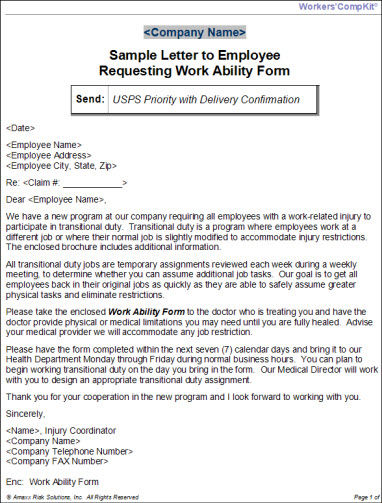
8. Form Letters to Employees
9. Supervisor's Guide to Work Injuries
10. Training Materials for Supervisors
Other materials may be added to the list, but these forms are must-haves for your files as they will be used over and over again. Make all materials accessible to your project team so when an injury occurs, it is easy for those at the scene to find and take with them the necessary documents when accompanying the injured employee to a medical care facility. Here are three forms to get you started; they will give you an idea of where you need to be if you are designing your own program. http://www.reduceyourworkerscomp.com/free-workers-comp-form.php
It is also important for all team members to be familiar with the forms and know how they are used and when. A checklist of documents needed by each department's is a good idea to put into place. If the wallet cards, for example, aren't handed out at hiring, it may be too late after an accident to find out a supervisor doesn't have one. You can start quite easily by jotting notes on a pad on your desk of types of communication materials that would be helpful. You don't have to be perfect, but you DO have to "get started."
Author Robert Elliott, executive vice president, Amaxx Risks Solutions, Inc. has worked successfully for 20 years with many industries to reduce Workers’ Compensation costs, including airlines, healthcare, manufacturing, printing/publishing, pharmaceuticals, retail, hospitality and manufacturing. Contact: Robert_Elliott@ReduceYourWorkersComp.com or 860-553-6604.
WC Calculator: http://www.reduceyourworkerscomp.com/calculator.php
TD Calculator: http://www.reduceyourworkerscomp.com/transitional-duty-cost-calculator.php
Do not use this information without independent verification. All state laws vary. You should consult with your insurance broker or agent about workers' comp issues.
©2010 Amaxx Risk Solutions, Inc. All rights reserved under International Copyright Law. If you would like permission to reprint this material, contact Info@ReduceYourWorkersComp.com
A Reader Writes…
I am just beginning to implement a workers' comp management program and I need help with controlling the events surrounding work related injuries. It seems when employees are injured, they leave work, go to their doctor and call in sick for a few days.
I need a tool to verify the extent of their injuries and keep me in the information loop. Can you suggest anything?
Rebecca Shafer Replies: The tool we use is called a work ability form . Similar forms have other names like Work Capacity Form, etc. Keep in mind, one of the benefits of a workers' comp management program is the ability to structure processes by building forms not only designed to capture injury events, but to control process after the injury occurs. Your work ability form can be customized to reflect how your company wants things done. Keep in mind, you must comply with all state and federal laws applying to your business.
The point of a work ability form is to track the injured employee through the healing process, with return-to-work as quickly as possible being the final goal.
Include instructions to the treating physician with your fax number and request the completed, signed form be faxed to you within 24 hours following the injury.
Calendar all upcoming appointment dates and be sure the treating physician has additional copies of your form to complete and return to you following each subsequent medical appointment.
Seven Basic Sections of a Work Ability Form
1. Employee Information
Get the patient's full name, home, cell, business phone numbers. Date, time and place of the injury. If you are multi-sited, get the employer's name. Make sure the employee signs the release of medical records section, if at all possible so the treating physician can fax to you the part of the form with a diagnosis, prognosis. Once you have the information you can begin to build a modified duty job to offer to the injured employee as soon it's appropriate to do so.
2. Injury Information
Gather as much information about the injury as you can. Is it a new injury, a recurrence? What part of the body was injured? What is the diagnosis and prognosis? What type of physical exam was conducted subsequent to the injury?
3. Treatment
What kinds of medications are administered? Is further treatment necessary? Will treatment include physical therapy, hand therapy, etc.? Were tests administered (CT Scan, MRI, EMG, X-Ray)? Include dates, times.
4. Work Ability
What is this patient's prognosis for returning to work? Did the treating physician review the patient's job description (that you ensured the patient brought with him to the treatment facility)? Was the doctor able to view a job analysis video really see what the patient's job entails?
What is the return to work status? Can the patient return to full duty with full restrictions, and if so, when? You need a specific date. Is the patient returning to work with some restrictions? What are the restrictions and how can you work with the treating physician to accommodate a modified duty position. Regardless of type of modified duty, you must require a return to work date. Ask: Will the patient remain off duty? If so, until when?
5. Physical Restrictions
The treating physician completes a detailed report of the patient's ability in physical functions such as keyboarding, squatting, kneeling, sitting, driving, standing, walking, etc. The initial report is used as a base line to compare against future work ability reports the patient and treating physician complete as the patient recovers. Make a note if the patient requires an assistive device such as a wheel chair or a cane, in order to factor its use your modified duty plan. (workersxzcompxzkit)
6. Next Appointment
The treating physician assign a follow-up examination date and makes comments in this section.
7. Medical Provider Signature
The treating physician swears everything entered into the form is true. Insert instructions to have the doctor's name printed as well as signed and dated.
\
Author Rebecca Shafer, Attorney, Consultant, Writer, Amaxx Risks Solutions, Inc. has worked successfully for 20 years with many industries to reduce Workers’ Compensation costs, including airlines, healthcare, manufacturing, printing/publishing, pharmaceuticals, retail, hospitality and manufacturing. Contact: RShafer@ReduceYourWorkersComp.com or 860-553-6604.
FREE WC IQ Test: http://www.workerscompkit.com/intro/
WC Books: http://www.reduceyourworkerscomp.com/workers-comp-books-manuals.php
WC Calculator: http://www.reduceyourworkerscomp.com/calculator.php
TD Calculator: http://www.reduceyourworkerscomp.com/transitional-duty-cost-calculator.php
Do not use this information without independent verification. All state laws vary. You should consult with your insurance broker or agent about workers' comp issues.
©2010 Amaxx Risk Solutions, Inc. All rights reserved under International Copyright Law. If you would like permission to reprint this material, contact Info@ReduceYourWorkersComp.com
The current recession is the second longest in our country's history. Per the National Bureau of Economic Research (NBER), the recession started in December 2007. In April 2010 the NBER let an internal split become public, some of the economists wanted to call the recession over but others did not, they wanted more data. For everyone related to the workers’ comp field, the recession is still here.
The Insurance Journal reports the combined loss ratio for workers' compensation insurers for 2008 was 101. [That means for every $100 the insurance companies took in, they paid out $101]. In 2009 the combined loss ratio for workers’ comp insurers jumped nine points to 110. It is hard to stay in business when you spend $110 for every $100 you earn.
According to the National Council on Compensation Insurance (NCCI), 2009 was really not that bad. The combined loss ratio would have been 107 except for one large carrier adding $1 billion to its excess workers’ comp reserves. Still, for all the other workers’ comp carriers, spending on average $107 for every $100 taken in is not a good thing.
The NCCI also reported net written workers’ comp insurance premiums dropped by 23% from 2007 to 2009. The primary cause of the downturn in premiums was the downturn in the economy. Among the companies hit the hardest by the recession were the employers in the construction and manufacturing fields. Both of these fields have higher than average workers’ comp premiums.
As the workers’ comp premium calculation is based on payroll, a great way to reduce premiums is to lay off workers. [Of course if you take that approach too far, you go out of business!]. The impact of employers laying off workers was less premiums being paid to the workers’ comp insurers, At the same time the premium collection was being reduced, the existing workers’ comp claims being paid. Hopefully, the workers’ comp insurers have adequate reserves set up on each claim, but if one company is adding $1 billion to reserves…it makes you wonder.
Workers’ comp insurers with loss ratios in excess of 100 know how to correct the loss ratio — they raise the workers’ comp premiums they charge to employers. However, they have to remain competitive in order to keep existing business and hopefully obtain new business.
The employers on the other hand should see some positive impacts on workers’ comp besides lower premiums due to fewer employees. The employees who are still employed tend to be the more experienced employees who have fewer accidents and injuries then less experienced employees. This results in the experience modification factor improving over time, resulting in a lower workers’ comp premium in the future.
The biggest impact of the recession on workers’ comp may be the psychological impact it has on employees. There are well-documented spikes in the number of workers’ comp claims for employers who close a factory or make other wholesale personnel reductions. Unscrupulous employees, believing they are about to be terminated, prefer the two-thirds of their average weekly wage from workers’ comp over the one-third of their average weekly wage from unemployment insurance (both workers’ comp indemnity benefits and unemployment insurance benefits vary by state).
Old injuries not a bother to the employee for years suddenly take a severe turn for the worse the week before the lay-off. Or, the employee who rarely works alone was working alone and strained his back the day before the lay-off. Or, the employee reports she was hurt months ago, and tried to tough it out, but can no longer stand the pain, and needs to go to the doctor now. Lay-offs are a challenge for the workers’ comp claims office as the claims come in a bunch and all the claims need to be investigated at the same time.
The flip side to workers’ comp fraud is the recession also spawns a drop in workers’ comp claims. There are the employees who have a legitimate workers’ comp injury, but in their effort to 'stay in good with the boss,' don't report their claim for fear it will move them closer to the top of the layoff list.
Another psychological impact is on the employees with an obvious injury and must report their claims. They do so reluctantly. These employees, who might have taken a few days off when they got hurt, decide they do not want to do anything to jeopardize their job. They chose to be at work when they could legitimately stay home. What would have been a workers’ comp indemnity claim becomes a workers’ comp medical only claim.
Of course there are also the employees who were truly injured and were out on disability benefits before a factory closing or layoff was announced. The psychological impact on them is a reluctancy to recover from their injury, as they know once they return to work, they will be terminated for lack of work. They are aware of the recession and are very concerned they will not be able to find another job.
The psychological impact also works the opposite way for the employee out on disability benefits. If they are not concerned about being terminated as soon as they return to work, they may try to convince their doctor they are ready and able to return to work. They fear if they stay out of work too long, it could cost them their job. (workersxzcompxzkit)
Hopefully when the National Bureau of Economic Research gives their next assessment all the economists will be in agreement that the recession is over. Even if the recession is over, it will take a while for the impact of the recession on workers’ comp to dissipate.
\Author Robert Elliott, J.D., Consultant/President, Amaxx Risks Solutions, Inc. has worked successfully for 20 years with many industries to reduce Workers’ Compensation costs, including airlines, healthcare, manufacturing, printing/publishing, pharmaceuticals, retail, hospitality and manufacturing. Contact her: RShafer@ReduceYourWorkersComp.com or 860-553-6604.
FREE WC IQ Test: http://www.workerscompkit.com/intro/
WC Books: http://www.reduceyourworkerscomp.com/workers-comp-books-manuals.php
WC Calculator: http://www.reduceyourworkerscomp.com/calculator.php
TD Calculator: http://www.reduceyourworkerscomp.com/transitional-duty-cost-calculator.php
Do not use this information without independent verification. All state laws vary. You should consult with your insurance broker or agent about workers' comp issues.
©2010 Amaxx Risk Solutions, Inc. All rights reserved under International Copyright Law. If you would like permission to reprint this material, contact Info@ReduceYourWorkersComp.com
How Do My Safety and Workers' Comp Management Programs Link Up?
Can we assume you read and put into place all the information about a workplace safety program from our post on Monday and your safety program is up and operating?
If you are not enforcing safety in your workplace (or don’t know how) you need to start by getting help, ideally by hiring a safety consultant. But, if a safety consultant’s salary is out of the budget, evaluate your worksite hazards and remedies and create a written step-by-step strategy for establishing a safety culture. Train yourself and your supervisors and then bring all employees into the safety loop.
Remember, safety compliance is not an option and failure to comply with safety rules has consequences. Bring this point home to all employees by tying the “consequences” to their performance reviews.
Safety and Managing Workers’ Compensation Programs
Make workers’ compensation management part of your safety strategy. In the event a work-related injury does occur, you and your employees are then trained to act immediately. Don’t be afraid of mentioning workers’ compensation management to your employees. It isn’t true employees then “get ideas” about “disappearing” forever on work comp. Actually, bringing workers’ comp management to the forefront of your work place culture has the opposite effect.
Employees trained from the beginning understand the employer’s return-to-work expectations – injured workers are expected to return to work as soon as able in a modified duty job capacity; they are contacted on a regular basis; they learn injured workers do not languish at home on a comp claim to become “psychologically disemployed.”
Use your workers’ compensation management communication tools to establish your expectations. Develop a brochure listing post injury response responsibilities for supervisors, witnesses and employees.
The brochure must contain medical contact information even in those states where employees get to pick the treating physician. Employers still can recommend treatment facilities and often employees opt to go to the recommended facility.
Summarize the post-injury response/medical contact information and safety rules on a laminated card employees wear with their badges on a lanyard. Then, all employees always carry the information with them.
Workers’ compensation management signage, just like safety signage, is posted in walkways, cafeterias, restrooms, work sites, and other places where employees work and gather. (workersxzcomxzkit)
A small business owner who takes the proactive step of integrating workers’ comp management with a safety program covers both sides of the “injury coin.” First, your safety plan prevents injuries. Second, if an injury occurs, your work comp management plan provides immediate help to the injured worker while taking control of the RTW issues and claim process.
Author Robert Elliott, executive vice president, Amaxx Risks Solutions, Inc. has worked successfully for 20 years with many industries to reduce Workers' Compensation costs, including airlines, health care, manufacturing, printing/publishing, pharmaceuticals, retail, hospitality and manufacturing. He can be contacted at: Robert_Elliott@ReduceYourWorkersComp.com or 860-553-6604.
Podcast/Webcast: Claim Handling Strategies
Click Here:
http://www.workerscompkit.com/gallagher/podcast/ Claim_Handling_Strategies/index.php
Do not use this information without independent verification. All state laws vary. You should consult with your insurance broker or agent about workers' comp issues.
©2010 Amaxx Risk Solutions, Inc. All rights reserved under International Copyright Law. If you would like permission to reprint this material, contact Info@ ReduceYourWorkersComp.com.
Owners of small businesses are called on to manage many aspects of their businesses. One area, workers’ compensation insurance, must not only be provided but also maintained at a high level to be cost effective while providing employees with excellent benefits if they are injured at work.
A solid workers’ compensation management implementation program is one adaptable to every infrastructure in every state and includes these key points.
1. Start at the beginning with the assessment.
2. Develop a policy, program, and procedures.
3. Integrate practices into your every day work culture.
4. Measure return to work and data benchmarking before and after to see how you’ve improved.
5. Train employees, and document decreased work related injuries.
6. Bring the data to your insurer and bargain for a better insurance rate.
Before you can begin to think about a workers’ comp program, you must first put into place and maintain a safety program. Here are a few key steps.
1. Begin by using immersing everyone (owner(s), supervisors, employees, contract workers, etc.) in the single, most important idea: safety is not an option. Everyone needs to be aware of the consequences of ignoring safety rules, tied to their performance evaluations.
2. Use ISO900 standards for a safe work environment. Ask your insurance company about this.
3. Structure the work environment so tools, machinery and office equipment are neatly stored.
4. Mark walkways with day-glo yellow tape and keep them free of debris.
5. Use non-slip grids and handrails to prevent slips and falls.
6. Use signs to warn of hazards, in both words and pictures.
7. Post safety reminders to employees to wear protective personal equipment. Signs need to be in English and any other language prevalent in your workplace.
8. Appoint a safety coordinator.
9. Require employees to attend safety meetings and to participate in safety control.
10. Fully train all employees in the safe performance of their job tasks, highlighting particular safety standards, techniques, issues and consequences for non-compliance.
Train in safety to the expectations of your particular workplace and environment. (workersxzcompxzkit)
Competent management of a work comp program is more than preparing your payroll and reporting claims. The employer must create an atmosphere of safety and implement an active workers’ compensation program at every level.
Author Robert Elliott, executive vice president, Amaxx Risks Solutions, Inc. has worked successfully for 20 years with many industries to reduce Workers' Compensation costs, including airlines, health care, manufacturing, printing/publishing, pharmaceuticals, retail, hospitality and manufacturing. He can be contacted at: Robert_Elliott@ReduceYourWorkersComp.com or 860-553-6604.
Podcast/Webcast: Claim Handling Strategies
Click Here:
http://www.workerscompkit.com/gallagher/podcast/ Claim_Handling_Strategies/index.php
Do not use this information without independent verification. All state laws vary. You should consult with your insurance broker or agent about workers' comp issues.
©2010 Amaxx Risk Solutions, Inc. All rights reserved under International Copyright Law. If you would like permission to reprint this material, contact Info@ ReduceYourWorkersComp.com.