
Find Out About Quality Claims Handling Services

MSP/MIR Compliance

Onsite Wellness Clinics, Nurse Triage, Pre-employment Screening

Physical Therapy and Rehabilitation


Work Comp Cost Reduction Book/Manual


Amaxx Details 2012 Workers Compensation Management Program Updates


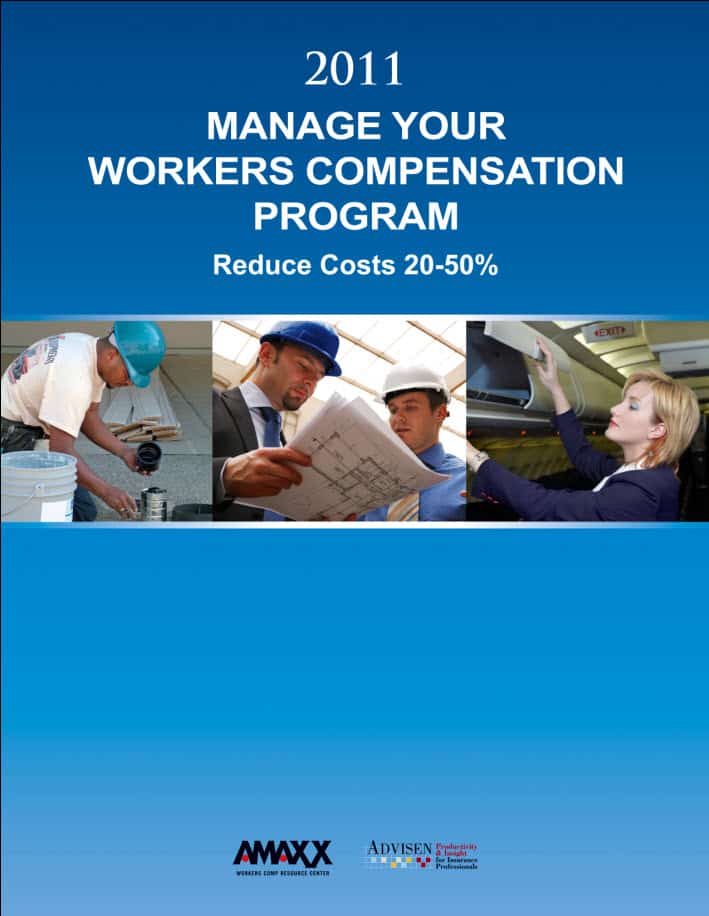
Workers’  Compensation Costs Can Be Reduced by Implementing Operational Best Practices: Learn How With This New Guidebook.
 
A company that wants to implement a new workers compensation program or revamp an existing system will find this book helpful. Maybe your company has recently expanded and you realize the need to train a workers compensation manager or regional coordinators how to hold down compensation costs. Whatever your need, here is the answer: Workers Compensation Management Program: Reduce Workers’ Comp Costs 20%-50%.
 
 
Used by more than 150 firms across the country, this is THE book to help every employer develop a more effective workers compensation program to reduce workers compensation costs. It is based on field research and decades of experience in workers compensation from all aspects of the business. Best practices are described in detail for each person in the injury process.
 
 
This easy-to-read manual has been updated for 2012. It now includes:
 
An index for quick topic look-up so you can view a term or a procedure and see all relevant references.
 
NEW – Workers Compensation Basics
Purpose of Workers Compensation
Who Pays for Workers Compensation?
Parties Involved in Workers Compensation
Benefits for the Employer
Independent Contractors
Benefits for the Employee
Injuries Covered
Types of Workers Compensation
How Losses are Categorized
How Losses are Reported
Calculating Your Premium
How Mod Effects Your Premium
Good/Bad Mod Example
Five Ways to Reduce Your Mod
 
NEW – Fundamentals of Cost Containment
Reasons Workers Compensation Costs are High
Who is in Charge?
Work Ability Form Properties
Who is Responsible for Managing Workers Compensation Claims?
Who is Responsible for Managing Workers Compensation Process?
Hidden (Indirect) Costs of Workers Compensation
Additional Costs
Calculating WC Costs
External Obstacles to Cost Control
Internal Obstacles to Cost Control
 
NEW – Working with Your Adjusters or TPA
Account Handling Instructions
MD Participation
 
NEW- Reporting a Claim
Critical Issues
Essential Intake Considerations
Nurse Triage
 
NEW- Directing Medical Care
Occupational Health Clinics
Remote Health Services
Directing Medical Care in California
 
NEW- Return to Work
What to Include in a Transitional Duty Policy
Non-Profit, Volunteer or Charitable Positions
Employees Who Never Return to Work
Coordinating WC with Federal and State Leave Statutes
 
NEW – Other Indemnity Cost Containment Services
Telephonic Disability Intervention
 
NEW – Medical Cost Containment
URAC Certification
Mental Health RNs
Chronic Pain Programs
An Aging Workforce
At Home Recovery Services
Medical Fee Schedules
Fee Schedule Coding
ICD-9 and CPT Codes
 

NEW- Physical Therapy and Physical Rehabilitation

Differences between Physical Rehabilitation Programs
Pharmacy Benefits Management Program
Authorized Drug Formulary
Toxicology Screening
 
NEW – Fighting Fraud and Abuse
Medical Terminology Used to Identify Malingering
Reviewing Investigation Reports and Videos
Avoid good Day/Bad Day Syndrome
 
NEW – Claims Resolution and Settlements
Conditional Payment and Final Demand
Pharmacy Component of MSA
California Settlement Process
 
 
A 183-page guide covering how to assess your workers compensation program, design program materials, roll out a program to the organization, and monitor and manage the program once implemented.
 
 
Written by a national expert on workers compensation cost containment with over 25 years experience helping companies reduce their losses 20% to 50%.
 
 
T. Ronca, a workers’ compensation defense attorney from Long Island, NY, said the book is an invaluable desk reference. “It is one of the tools that should never be out of reach for a risk manager. Direct employer involvement with claims in the first weeks is the difference between success and failure. This manual will guide the conscientious employer through the pitfalls,” Ronca said.
 
 
What’s more, the book can be delivered with your company logo on the cover and a full-color ad for your company on the back cover. 

Take it out to the field. Text tabs are available to put on each chapter and it is ready to go as your company training manual. All you will have to do is customize the Training Agenda that is in Part I of the book.


Included in the manual are topics such as: Return to work and transitional duty, claim reporting, employee communications, controlling fraud and abuse, directing medical care, medical cost containment solutions, post injury response procedures, reporting procedures, working with your carrier and third party administrator. There is information about physical therapy, pharmacy benefits management programs, training supervisors and gaining management commitment. It also contains concepts of claim settlement and resolution as well as safety and loss control. New areas are identified above.
 
 
There are 5 sample worksheets in the manual to help organize an efficient workers’ compensation program. These include: timetable for implementation, the injury coordinator job description, and several sample roll-out letters. We recently received a terrific phone call from a third-party administration firm saying how the manual provided an organized way to train clients at loss prevention and has helped their clients put "layers of better WC management" in place. Everyone benefited.
 
 
One large distribution firm wrote to us to say the chapter on safety and loss control led to a company-wide safety change that only cost a few hundred dollars but prevented a specific type of injury that had been draining its budget, says Rebecca Shafer, Esq., President of Amaxx Risk Solution, Inc. who authors the book. Shafer is a national expert on workers’ compensation cost containment with more than 25 years of industry experience helping many companies reduce their losses 20-50%.
 
 
When you order your copy of Manage your Workers’ Compensation Program from Advisen at http://corner.advisen.com/wcbooks, the 183-page guidebook shows how to assess your program, design program materials, roll-out a program to the organization, and monitor and manage the program once implemented.
 
 
The workbook is also available with a customized front and back cover for bulk purchases. Discounted rates apply to bulk orders.
 
 
One company said, "After reading the manual, we took a look at past workers comp practices and saw that every department did things differently. Manage Your Workers’' Compensation Program 2012 gave us the guidance we needed to standardize our workers’ compensation programs across the country. It was like a pre-prepared lesson plan," according to the risk manager.
 
 
A regional hospital in North Dakota wrote that, "Our small company expanded rapidly and we actually didn’t have any official workers’ compensation program in place. This manual gave us step-by-step procedures from the first meetings with management to monitoring the final program. Buying and reading the book was almost like hiring another employee – one who was an expert in workers’ compensation."
 
 
Who Uses the Workers’ Compensation Book?
Risk Managers and Workers’ Comp Managers find it useful learning about the cost containment niche and use it for themselves and to bringing new team members up to speed very quickly. The book becomes a “lesson plan” tool.
 
 
Safety Directors use the book to train supervisors in workers’ compensation claims management. They learn more about their area of responsibility — post loss cost containment — adding to their overall knowledge. They also learn what to do after an injury and what steps are supposed to take place during the first 24 hours.
 
 
Brokers use it for prospects, as well as, to learn about specific aspects of cost containment, passing their knowledge on to their clients. For example, when discussing how to develop a return-to-work program and a client asks about, “off-site return-to-work programs,” the broker quickly finds the relevant section in the book, reviews it and passes the answer on to the client, along with a copy of the cost containment book with the broker’s logo.
 
 
Adjusters use the book to gain a better understanding of the employer’s perspective. Adjusters also want to learn more about cost containment to add to their overall workers’ compensation knowledge in order to grow their careers and stay abreast of new services.
 
 
Account Producers give the book to prospects during formal presentations to illustrate their company is on top of the workers’ compensation industry. The book makes an excellent client gift.
 
 
Vendors such as doctors, physical therapy networks, occupational clinics and medical management firms learn how their service might fit into the workers’ compensation marketplace, what is important to employers, and what they look for in medical services to enable the vendors to enter the workers’ compensation marketplace.
 
 
The manual is a cost-cutting tool to learn more about systematic and operational techniques for reducing workers compensation costs.


Author Rebecca Shafer, JD, President of Amaxx Risk Solutions, Inc. is a national expert in the field of workers compensation. She is a writer, speaker, and publisher. Her expertise is working with employers to reduce workers compensation costs, and her clients include airlines, healthcare, printing/publishing, pharmaceuticals, retail, hospitality, and manufacturing. She is the author of the #1 selling book on cost containment, Workers Compensation Management Program: Reduce Costs 20% to 50%. Contact: RShafer@ReduceYourWorkersComp.com.
 
 
2012 NEW WORKERS COMP MANAGEMENT GUIDEBOOK:  www.WCManual.com
 
WORK COMP CALCULATOR:  www.LowerWC.com/calculator.php
MODIFIED DUTY CALCULATOR:  www.LowerWC.com/transitional-duty-cost-calculator.php
WC GROUP:  www.linkedin.com/groups?homeNewMember=&gid=1922050/
SUBSCRIBE:  Workers Comp Resource Center Newsletter
 
Do not use this information without independent verification. All state laws vary. You should consult with your insurance broker or agent about workers comp issues.
 
©2012 Amaxx Risk Solutions, Inc. All rights reserved under International Copyright Law. If you would like permission to reprint this material, contact us at: Info@ReduceYourWorkersComp.com.
Posted in Claim Audits & File Review, Communication with Employees, Coordinating Medical Care, Federal Workers Compensation, Fraud and Abuse, Insurance Issues, Rates, Premiums, Lowering Premiums & Experience Mod, Management Commitment, Medical Cost Containment & Managed Care, Medicare Set Asides (MSAs), Professional Development Issues, Return to Work and Transitional Duty, Risk Management, Safety and Loss Control, Settling WC Claims, TPA and Claims Administration, WC 101, WC in Other Countries (International) |


Comments Off

7 Keys to Reducing Workers Compensation Losses in 2012


It is never too late to start thinking about how to be more proactive when it comes to handling your insurance losses. You can implement a program or plan any time, provided you roll it out to the right people and your employees or workers understand the initiatives and reasons behind it.
 
 
Sometimes workers don’t understand how insurance works. Commercial insurance is a monster to address. It is hard to explain how an underwriter comes up with the numbers they do in order to assign a premium to your workplace. But the bottom line that should be communicated is that every dollar that goes out from the insurance company/TPA could affect the insurance cost. If you have higher costs, maybe you cannot give out higher bonuses. Or maybe increased costs result in certain workers not getting a pay raise. All workers will understand when you put it into a sense of how if affects them directly. So let’s go over some simple loss reduction techniques to refresh your mind for 2012:
 
 
1. Make a commitment to promoting safety
If you are going to do this, go all out. You need to establish the rules and procedures, and then you need to come up with a way to drill it into everyone’s mind. The perfect way is by having rules enforced, and violators punished. Not harsh, severe punishments, but more than a slap on the wrist. Make them park in the back of the lot. Make them wear a different color safety hat than everyone else, or a vest that claims they broke the safety rules. Have the punishment be something that is part tongue-in-cheek, but it gets the point across and leads to some good natured ribbing from other coworkers.
 
 
On the other side, reward safety achievements. Use gas cards or coupons for free food as gifts. Do raffles and hand out a few prizes to the person that was the most safety-oriented. Whatever you do, make the reward something more tangible than a pat on the back.
 
 
Also you can post safety rules and violations on signs and place them all over your work floor, in the bathrooms, in the break areas, etc. Make sure they are at eye-level where people can see them, and color them accordingly so they are hard to miss. Use diagrams and stick people to represent the injury that could occur if you stuck your hand into the saw blade with the machine on. If may seem elementary, but your workers will see those drawings everyday and probably laugh at them, but the more they look at them, the more they remember, and the safer they just might be.
 
 
2. Make safety paramount
When you have a safe work environment, you have more productive employees. This is due to the fact that your safe machines are running like they should. Nobody is worried about something breaking or someone getting injured by doing certain jobs. Safe workplaces have fewer workers comp claims.
 
 
Obviously there is a direct link between safety and work comp. The less safe you are, the more work comp injuries you will have. And that leads into higher premium exposure. If your claims skyrocket, the costs increase, and that could increase the cost of your premium for your work comp policy. So it all begins with safety. Safety is the key to keeping comp costs down. Which, in-turn, controls premium costs.
 
 
3. Have well-defined safety policies and the need to implement them
If workers are not following the safety rules, that is a problem. A rare violator that has to wear the vest of shame is one thing. But if you have a guy breaking the safety rules everyday, you have an issue. You have to investigate why the worker is not following the rules. Document your findings, and then follow through with safety training or re-education on the proper safety function for the particular machine or device they may be using. Maybe they were taught by another employee to use the machine incorrectly. Whatever the reason, investigate it, document it, then retrain and follow through until the person understands and is capable of safely operating the device or doing the work task within your defined safety rules and procedures.
 
 
4. Can the employer fire a worker that disobeyed a direct, known safety protocol?
Wow, is this a Pandora ’s Box of a question!!!!! There are numerous case law decisions within any jurisdiction that comment on this matter. I hear this question ALL THE TIME! The answer is "Yes, sometimes" and "No, at other times." 

My advice is to always consult your counsel and adjuster before you do anything. Improper termination may open yourself to a world of fines and legal issues, and even though you think you may be doing the right thing that is not for you to decide. Consult your attorney before ever making such a decision. The choice will vary by accident, and no two will be the same.


5. Safety violations cost employers money!
If people are hurt, they cannot do their job, which decreases production, which in turn decreases profit. Jobs get completed late, others have to make up for the gap in work, etc. As mentioned earlier, safety violations in any form will always cost you money. The safer you are, the more productive, the more profitable. 
 
Think Zero Accidents as your goal! People say, "Oh, that's impossible." But it's only impossible if you don't try.  
 
 
6. High employee morale helps to reduce losses
Several studies show the link between morale and workers comp losses. Happy workers are happy because they have jobs they like; they have manageable workloads, safe working environments, etc. Disgruntled employees are overworked, underpaid, and under stress. They typically are working with potentially unsafe materials, in an unsafe shop, where there is a lot of risk for injury. Sooner or later they will stumble upon that risk, and injure themselves.
 
 
Actually the studies linking morale to work comp show they are linked up mostly in subjective injuries: back pain, muscle pain, headaches, etc. The more unhappy the workforce, the more subjective claims seem to surface.
 
 
7. Timely claim reporting saves money
And as always, and we say it time and time again, the sooner you get that work comp claim to your carrier to be assigned to an adjuster, the quicker they are on the case, the better the result will be. The more you delay in calling it in, the more it will cost you down the road.  WCxKit
 
 
So, remember, it’s never too late to start thinking about safety, and how it impacts your bottom line. Think carefully about each job task and what risks your workers face. Solicit feedback from your employees. Involve them in this process, and hear what they have to say. The more they are involved, the more they will participate, and the more successful your program will be. Be safe!

Author Rebecca Shafer, JD, President of Amaxx Risk Solutions, Inc. is a national expert in the field of workers compensation. She is a writer, speaker, and website publisher. Her expertise is working with employers to reduce workers compensation costs, and her clients include airlines, healthcare, printing/publishing, pharmaceuticals, retail, hospitality, and manufacturing. She is the author of the #1 selling book on cost containment, Manage Your Workers Compensation: Reduce Costs 20-50% www.WCManual.com. Contact: RShafer@ReduceYourWorkersComp.com.
 

NEW 2012 WORKERS COMP BOOK:  www.WCManual.com 
WORK COMP CALCULATOR:  www.LowerWC.com/calculator.php

 
Do not use this information without independent verification. All state laws vary. You should consult with your insurance broker or agent about workers comp issues.
 
©2011 Amaxx Risk Solutions, Inc. All rights reserved under International Copyright Law. If you would like permission to reprint this material, contact Info@ReduceYourWorkersComp.com.
Posted in Communication with Employees, Management Commitment, Safety and Loss Control |


Comments Off

Two New England Employers Cited for Injuries and Hazards


The U.S. Department of Labor's Occupational Safety and Health Administration (OSHA) has cited Prolerized New England Co. LLC, doing business as Schnitzer Northeast, for 10 alleged serious violations of workplace safety standards at its Everett recycling facility, where two workers were injured. Proposed penalties total $70,000.
 
 
According to OSHA officials, the employees were performing maintenance work inside a large rotating drum used to sort scrap material for recycling when the drum activated, injuring them. OSHA's Andover Area Office conducted an inspection in response to the September incident and identified several serious deficiencies in the facility's hazardous energy control procedures, which should ensure machines are deactivated and their power sources locked out before employees perform maintenance work.(WCxKit)
 
 
In this case, the procedures were incomplete and not clearly communicated, training was inadequate, and the procedures were not reviewed to ensure that they were effective and understood by the employees.
 
 
The inspection also found that the employees were not trained to work in confined spaces, such as the drum, and were not provided a hot work permit for welding performed in the drum. Finally, the employees were exposed to the hazard of falling into the drum through an unguarded chute opening. OSHA assessed the maximum fine of $7,000 for each of the violations, for a total of $70,000 in fines. A serious violation occurs when there is substantial probability that death or serious physical harm could result from a hazard about which the employer knew or should have known.
 
 
"The unexpected startup of machinery during maintenance can injure or kill workers in seconds," said Jeffrey Erskine, OSHA's area director for Essex and Middlesex counties. "Preventing this hazard requires a combination of effective hazard control procedures, training and diligence to ensure that the proper safeguards are in place, in use and understood by workers."(WCxKit)


The company has 15 business days from receipt of its citations and proposed penalties to comply, meet with OSHA's area director or contest the findings to the independent Occupational Safety and Health Review Commission.


OSHA Fines Connecticut Employer for Exposing Workers to Injury 

The U.S. Department of Labor's Occupational Safety and Health Administration (OSHA) recently cited G.A. Denison & Sons Inc. for 14 alleged willful and serious violations of workplace safety standards at an Old Lyme work site. The New London contractor faces a total of $110,000 in proposed fines, according to an OSHA report.
 
OSHA's enforcement action follows an inspection opened June 7, when Denison & Sons employees were observed being exposed to falls from heights of 15–26 feet while working without protection on both a scaffold and the roof of a building located at 69 Lyme St. (WCxKit)
 
 
In addition, OSHA found employees exposed to fall hazards while improperly climbing ladders and climbing ladders while carrying materials on their shoulders, as well as to head injuries from working without hard hats. These conditions resulted in citations for five willful violations carrying $73,700 in fines. A willful violation is one committed with intentional knowing or voluntary disregard for the law's requirements, or with plain indifference to worker safety and health.
 
 
Nine serious violations, with $36,300 in fines, have been cited for several other hazardous conditions, including overloaded scaffolding, a lack of eye protection for employees using nail guns, inadequate scaffold access, a lack of protection against falling objects, and a failure to provide employees with fall protection, scaffold, and ladder training. A serious violation occurs when there is substantial probability that death or serious physical harm could result from a hazard about which the employer knew or should have known. (WCxKit)
 
 
OSHA has placed G.A. Denison & Sons in its Severe Violator Enforcement Program, which mandates targeted follow-up inspections to ensure compliance with the law.
 
 
Author Robert Elliott, executive vice president, Amaxx Risk Solutions, Inc. has worked successfully for 20 years with many industries to reduce Workers Compensation costs, including airlines, healthcare, printing/publishing, pharmaceuticals, retail, hospitality and manufacturing. He is an editor and contributor to Workers Compensation Management Program: Reduce Costs 20% to 50%. Contact: Info@ReduceYourWorkersComp.com.


WORKERS COMP MANAGEMENT GUIDEBOOK:  www.WCManual.com
 
WORK COMP CALCULATOR:  www.LowerWC.com/calculator.php
MODIFIED DUTY CALCULATOR:  www.LowerWC.com/transitional-duty-cost-calculator.php
WC GROUP:  www.linkedin.com/groups?homeNewMember=&gid=1922050/
SUBSCRIBE:  Workers Comp Resource Center Newsletter
 
Do not use this information without independent verification. All state laws vary. You should consult with your insurance broker or agent about workers comp issues.
 
©2012 Amaxx Risk Solutions, Inc. All rights reserved under International Copyright Law. If you would like permission to reprint this material, contact us at: Info@ReduceYourWorkersComp.com.
Posted in Legal Doctrines, Litigation Management, Management Commitment, Uncategorized |


Comments Off

Porn Industry Requires Condom Use for Workers Safety, Workers Revolt


Earlier this month the Los Angeles City Council passed an ordinance requiring condoms to be used in all permitted adult films shot within their city limits. It brings up many interesting workers compensation issues. After all, this requirement is for the health and safety of employees. Is it any different from requiring construction workers to wear a helmet? Road workers to wear a bright, orange vest?
 
 
In this commentary on Salon.com porn performer, writer and director Lorelei Lee calls the ordinance well intentioned but ineffectual. She notes that the new law requires adult film production companies to pay a fee with permit applications. “Currently, condoms are used in the mainstream gay adult film industry (which includes only gay male films), while the heterosexual industry (which includes both lesbian and straight films) has used mandatory STI (sexually transmitted infections) testing as a health and safety precaution since the early 2000s,” she writes.
 
 
Lee writes that until May of 2011, the Adult Industry Medical Center, founded by a retired performer, ran a nationwide STI testing service and database that certified heterosexual performers as STI-free previous to their working on any production whereas the new ordinance is in response to a San Francisco-based nonprofit AIDS Healthcare Foundation campaign along with other groups that have picked and boycotted companies which sell or show condom-free pornography.
 
 
One of the protest leaders called the testing service a “fig leaf” over the adult industry and backed the lawsuit that led to the organization’s financial insolvency and shutdown last year, which left a vacuum in health and safety protections in the industry, Lee writes. “(He) seemed to hope that leaving performers without any kind of health protection would force legislators to mandate condom use,” she writes.
 
 
Lee writes that she became a condom-only performer in 2010 but had worked for eight years previously relying only on the testing service. “But during my time as a non-condom performer, I never once contracted an STI on set that condoms would have prevented, and truthfully, I’m not sure that condoms actually keep me safer than testing alone,” she writes.
 
 
She writes that performers have a mix of opinions as to whether they mind actually using condoms on set and some are even strongly opposed to using condoms at work, believing that they may actually increase likelihood of STI transmission.
 
 
Lee says what she is most opposed to is regulating condom use in the industry through government regulation. “Many of the people attracted to this industry are still those who don’t care a lot about public opinion or about obeying authorities. In the case of a condom mandate tied to permits, many producers will simply shoot in Los Angeles without a permit. Others will move production outside of the city – to places like Las Vegas, San Francisco or Miami, where some companies are already established,” she writes, noting that perhaps that s what the city is after.
 
 
In effect, Lee writes, this legislation has made it more difficult for the industry to use the protections already in place with AIM’s testing program. “We’re also opposed to the squandering of AHF resources – resources that could be effectively used to help prevent and treat HIV and AIDS – on a political campaign against an industry whose health and safety regulations are already working. In the decade since AIM began the program of mandatory testing, six performers have tested positive for HIV, and only three of those have shown to be from on-set transmissions,” she writes. “That’s three transmissions during the course of filming tens (or perhaps hundreds) of thousands of scenes. There are no real statistics as to how this compares to transmission rates in the general population.”


Author Rebecca Shafer, JD, President of Amaxx Risk Solutions, Inc. is a national expert in the field of workers compensation. She is a writer, speaker, and publisher. Her expertise is working with employers to reduce workers compensation costs, and her clients include airlines, healthcare, printing/publishing, pharmaceuticals, retail, hospitality, and manufacturing. She is the author of the #1 selling book on cost containment, Workers Compensation Management Program: Reduce Costs 20% to 50%. Contact: RShafer@ReduceYourWorkersComp.com.
 
 
ALL NEW 2012 WORKERS COMP MANAGEMENT GUIDEBOOK:  www.WCManual.com
 
WORK COMP CALCULATOR:  www.LowerWC.com/calculator.php
MODIFIED DUTY CALCULATOR:  www.LowerWC.com/transitional-duty-cost-calculator.php
WC GROUP:  www.linkedin.com/groups?homeNewMember=&gid=1922050/
SUBSCRIBE:  Workers Comp Resource Center Newsletter
 
Do not use this information without independent verification. All state laws vary. You should consult with your insurance broker or agent about workers comp issues.
 
©2012 Amaxx Risk Solutions, Inc. All rights reserved under International Copyright Law. If you would like permission to reprint this material, contact us at: Info@ReduceYourWorkersComp.com.
Posted in California Workers Comp, Communication with Employees, Drug, Alcohol & Impairment Testing, Employment Law Issues, Management Commitment, Risk Management, Safety and Loss Control, Wellness Programs and WC |


Comments Off

Nova Scotia Area Fishermen Reminded of Safety Practices


Fishermen across South Shore and Southwest Nova Scotia are being reminded by the Workers Compensation Board of Nova Scotia (WCB) and the Department of Labor and Advanced Education to practice safe fishing and avoid injuries.
 
 
“Fishing is one of the most dangerous occupations in the province, particularly in the harsh winter months,” said Stuart MacLean, acting CEO of the WCB. “We want to remind everyone in the industry to wear proper life vests and check their safety equipment and work procedures to ensure no one gets hurt this season.”(WCxKit)
 
 
In 2010, nearly 400 people working in the fishing industry were injured on the job. Of those, 150 were serious injuries that resulted in time lost from work. In the last three years alone, 23 people have died while working in the fishing industry. That is more than a quarter of all workplace fatalities in Nova Scotia during that time.
 
 
While injuries related to weather, conditions at sea and overloaded boats are often serious and tragic, sprains and strains are common and financially costly. These injuries are caused by hazards associated with the way work is designed and carried out such as lifting heavy loads.
 
 
The seafood processing sector also had its share of injury, with more than 400 injuries in 2010, including nearly 100 injuries causing time lost from work.
 
 
“Fishing is a vital part of our culture in Nova Scotia,” said Marilyn More, Minister of Labor and Advanced Education. “That work has incredible value, contributing millions to our economy every year. It is critical that this work be done safely; to reduce the terrible human and financial toll workplace injury takes in this province.”
 
 
Seafood processors and any fishing vessel that is based in Nova Scotia must comply with the province’s Occupational Health and Safety Act.
 
 
Premiums paid by fishing industry employers for workplace injury insurance are among the highest in Nova Scotia. The 2012 rate is $7.85 per $100 of payroll, up from $7.50 in 2011. That’s well above Nova Scotia’s average assessment rate of $2.65 – a direct result of the number and severity of injuries in the fishing sector.
 
 
There are positive signs that the fishing industry is taking action to improve its safety performance. In 2010 the Fisheries Safety Association was established with a mandate of reducing workplace injuries, and over time, workers’ compensation rates.
 
 
The WCB partnered with the Fisheries Safety Association and Advanced Labour and Education to produce an advertising campaign featuring hard-hitting safety messages such as “What’s harder? Telling your crew to put on lifejackets or telling their families they aren’t coming home?”(WCxKit)
 
 
“We are making progress establishing a safety culture in Nova Scotia, and by working together we can extend that progress to the fishing sector,” said MacLean. “The fishing industry needs a clear focus on safety. Fishermen have faced dangerous conditions for too long.”
 
 
Author Robert Elliott, executive vice president, Amaxx Risk Solutions, Inc. has worked successfully for 20 years with many industries to reduce Workers Compensation costs, including airlines, healthcare, printing/publishing, pharmaceuticals, retail, hospitality and manufacturing. He is an editor and contributor to Workers Compensation Management Program: Reduce Costs 20% to 50%. Contact: Info@ReduceYourWorkersComp.com.


NEW 2012
WORKERS COMP MANAGEMENT GUIDEBOOK:  
www.WCManual.com
 
WORK COMP CALCULATOR:  www.LowerWC.com/calculator.php
MODIFIED DUTY CALCULATOR:  www.LowerWC.com/transitional-duty-cost-calculator.php
WC GROUP:  www.linkedin.com/groups?homeNewMember=&gid=1922050/
SUBSCRIBE:  Workers Comp Resource Center Newsletter
 
Do not use this information without independent verification. All state laws vary. You should consult with your insurance broker or agent about workers comp issues.
 
©2011 Amaxx Risk Solutions, Inc. All rights reserved under International Copyright Law. If you would like permission to reprint this material, contactInfo@ReduceYourWorkersComp.com.
Posted in Management Commitment, Risk Management, Safety and Loss Control, WC in Other Countries (International) |


Comments Off

Ohio BWC Unveils Workplace Wellness Program


Ohio Bureau of Workers Compensation (BWC) Administrator/CEO Stephen Buehrer recently announced the addition of a workplace wellness program to help employers meet the challenges related to rising incidences of obesity and chronic disease.


Over the next four years, the program will make $4 million available to employers to create programs to control escalating costs of workers’ compensation claims associated with these health risk factors.(WCxKit)


“Health factors like obesity and chronic disease can contribute to workplace injuries and slow the recovery of an injured worker,” said Buehrer. “By promoting wellness programs in the workplace, we are helping improve the quality of life for working Ohioans and their families, as well as helping reduce costs for Ohio’s employers.”


Participating employers will be awarded up to $15,000 over four years to implement wellness programs in their workplaces. BWC expects more than 600 employers will benefit from these grants, which will be awarded on a “first come, first serve” basis based on availability of funds.


Author Robert Elliott, executive vice president, Amaxx Risk Solutions, Inc. has worked successfully for 20 years with many industries to reduce Workers Compensation costs, including airlines, healthcare, printing/publishing, pharmaceuticals, retail, hospitality and manufacturing. He is an editor and contributor to Workers Compensation Management Program: Reduce Costs 20% to 50%. Contact: Info@ReduceYourWorkersComp.com.


2012 WORKERS COMP MANAGEMENT GUIDEBOOK:  www.WCManual.com
 
WORK COMP CALCULATOR:  www.LowerWC.com/calculator.php
MODIFIED DUTY CALCULATOR:  www.LowerWC.com/transitional-duty-cost-calculator.php
WC GROUP:  www.linkedin.com/groups?homeNewMember=&gid=1922050/
SUBSCRIBE:  Workers Comp Resource Center Newsletter
 
Do not use this information without independent verification. All state laws vary. You should consult with your insurance broker or agent about workers comp issues.
 
©2011 Amaxx Risk Solutions, Inc. All rights reserved under International Copyright Law. If you would like permission to reprint this material, contactInfo@ReduceYourWorkersComp.com.
Posted in Management Commitment, Risk Management, Wellness Programs and WC |


Comments Off

Survey Says Consumers Want Employers to Do More with Health Plans


As U.S. companies continue to ask workers to shoulder a greater burden of the cost of health care, a recent survey from Aon Hewitt, The Futures Company and the National Business Group on Health, reveals that consumers want their employers to do more to help them improve their health and get the most from their employer-provided health and wellness plans.


Together with the National Business Group on Health and The Futures Company, Aon Hewitt surveyed more than 3,000 consumers (employees and their dependents) covered by employer health plans to determine their perspectives, behaviors and attitudes towards health and wellness.(WCxKit)


Under continued pressure to mitigate costs and adjust to new regulations, employers are continuing to carefully consider the future of their employer-provided health plans. However, as they adjust their plan design and wellness strategies, the survey finds that many employers are not aligning these strategies with the goals, needs and concerns of their employees.


While a majority of consumers (74 percent) are worried about being able to afford health care now and in the future, they understand that health improvement programs, along with well-designed employer-provided health benefit plans, can help them get healthier while also holding down costs. But, the survey reveals that workers really want four simple things -programs and communication that are easy to use, motivating and meaningful to them, but that also provide personalized information and ideas.


"Employers continue to face countless challenges when it comes to offering health plans that effectively meet the needs of workers and their families, while also managing rising costs," said Helen Darling, president and CEO of the National Business Group on Health. "We hear over and over that the key to ensuring real health improvement is employee engagement, so knowing what employees want and what will motivate them is essential to success. Consumers are telling us that the one-size-fits-all approach to health and wellness is not working for them. In order to help with their challenges and reduce costs, they want health programs that speak to their individual and families' health care needs."


Faced with rising health care costs and new regulations, more employers are introducing health care plans that require workers to take more responsibility for managing their health and the related costs. In fact, a recent Aon Hewitt report shows that 51 percent of employers now offer a Consumer Driven Health Plan (CDHP), up from just 9 percent in 2005.


The good news for employers is that consumers are willing to try CDHPs if the immediate cost savings are apparent. Among those with a choice, most employees (63 percent) select a CDHP because of the lower premium costs.


Additionally, 39 percent choose this plan option because their employer contributes to an associated account-Health Savings Account (HSA) or a Health Reimbursement Account (HRA). In fact, among those enrolled in a CDHP who have a choice, over 90 percent will definitely or probably re-enroll. While CDHPs are, in part, intended to encourage workers to take a more active role in their health, the survey findings indicate that they are having a mixed effect on behaviors.


Encouragingly, 42 percent are getting more preventive care and 40 percent are looking for lower cost health services options since choosing this plan. More troubling, a sizeable number of workers (35 percent) are sacrificing or postponing care (28 percent) to avoid out-of-pocket costs.


"While an eye towards cost is certainly a valid and reasonable reason for consumers to select a certain health care plan, choosing a plan that fits a worker's lifestyle and needs also ensures that people are getting the most appropriate coverage for their needs," said Cathy Tripp, managing principal Health & Benefits at Aon Hewitt and project leader for this study. "However, employers need to make sure workers aren't sacrificing health and the future costs of poor health for lower costs today. Giving employees the tools and advice to decide what is the most appropriate plan for them is critical."


When it comes to tools to help them make health decisions, consumers want information that is tailored to their specific situation. Half of participants (50 percent) want a personalized plan that recommends specific actions they can take to improve their health based on their health status, up 9 percentage points from 2010. Workers are also looking for convenient, one-stop access to information with 40 percent expressing a preference for a wellness website and more than a third (35 percent) want personalized health tips and reminders. Cost is still not far from the minds of consumers though. Fully 44 percent would like cost savings tips and a third (33 percent) want cost estimating tools.


"If companies truly want to move the needle in terms of overall health and cost, they have to stop looking at employees as one group, and start looking at the individual," stressed Joann Hall Swenson, principal and health engagement best practice leader at Aon Hewitt. "Employers can customize health information and related programs to address the specific health conditions and risks of their workers as well as offer specific tips and actionable steps they can take to improve their condition. In addition, offering tools that allow individuals to see and understand the cost of their health care services goes a long way in helping workers make the most of their health care dollars."


In addition to shifting a greater share of the cost to employees, companies are also looking at ways to get employees and their dependents healthier. According to consumers, the best way to motivate them to participate in employer-sponsored health plans is by using rewards. More than half of consumers would prefer either non-cash or cash incentives to encourage them to take part in wellness (60 percent), condition management programs (50 percent) or respond to a health risk questionnaire (58 percent).


For employers, getting workers engaged in their health is critical to health improvement and cost containment. However, the survey finds that there is a disconnect between how healthy people think they are and how healthy they actually are.


The Centers for Disease Control and Prevention reports that approximately one-third (33.8 percent) of U.S. adults are obese, though only 24 percent of survey participants say they are obese. Similarly, the survey found that more than three-quarters (76 percent) of consumers rated their health as "very good" or "good,” while just 15 percent considered their health "fair" or "poor." While employees may think they are healthier than they likely are, they do acknowledge that their health is not perfect. Approximately 60 percent of consumers report having at least one health condition with obesity, high blood pressure and back pain most often mentioned.


"This lack of awareness between real and perceived health is a huge problem since we know that concerns about risk factors can help overcome our natural tendency to put-off making the tough life changes needed to significantly reduce health risks," stressed Darling.


Despite the potential disconnect between real and perceived health status, consumers do understand what it takes to get and stay healthy. When ranking what matters most to their health, many (85 percent) say that good health is a result of making smart health choices each day, over two-thirds (68 percent) say that getting regular preventive care ranks in the top three, while 40 percent rank living and working in a healthy environment in the top three. While people know what it takes to be healthy, there are still often barriers to reaching health goals. Most people cite lack of time (42 percent), cost (40 percent) and unwillingness to sacrifice (35 percent) as the leading obstacles to getting and staying healthy.


Consumers do acknowledge that there are people and things in their lives that may help move the needle when it comes to improving their health. Nearly three-quarters (72 percent) are influenced by advice from a doctor, almost half (47 percent) from friends or family, and 41 percent from general health websites. Just 13 percent consider health information from their employer a trusted source.


To improve health and productivity, employers are increasingly offering programs to both workers and their dependents such as biometric screenings, health risk assessments, onsite clinics/pharmacies and Employee Assistance Programs. However, many employees and their dependents do not seem to be aware of many of these programs. In 2011, more than one-third (36 percent) of consumers did not participate in any health program or service offered by their employer. Among the programs that workers did participate in, blood tests or biometric screenings were the most popular (61 percent participation), followed by health risk assessments (57 percent participation).


Despite low participation, when workers do take part in these programs, satisfaction is extremely high. Almost all (97 percent) of consumers who took part in blood work/biometric screening were satisfied, 97 percent were happy with their on-site clinic or pharmacy, and 92 percent were satisfied with the health risk assessment.


In addition to lack of awareness, and despite the availability of health improvement programs, many consumers do not feel their employers are fully supportive in helping them get and stay healthy. A majority of workers (60 percent) think their company is only moderately-to-not supportive when it comes to their efforts to be healthy.(WCxKit)


"Employers may be missing the mark when it comes to health improvement programs being offered to workers," said Tripp. "Workers need to see that their efforts to become healthy are supported by the company. Developing a culture where leaders care and support healthful living communicates to workers that this matters to the company."
 
 
Author Robert Elliott, executive vice president, Amaxx Risk Solutions, Inc. has worked successfully for 20 years with many industries to reduce Workers Compensation costs, including airlines, healthcare, printing/publishing, pharmaceuticals, retail, hospitality and manufacturing. He is an editor and contributor to Workers Compensation Management Program: Reduce Costs 20% to 50%. Contact: Info@ReduceYourWorkersComp.com.
 
 
WORKERS COMP MANAGEMENT GUIDEBOOK:  www.WCManual.com
 
WORK COMP CALCULATOR:  www.LowerWC.com/calculator.php
MODIFIED DUTY CALCULATOR:  www.LowerWC.com/transitional-duty-cost-calculator.php
WC GROUP:  www.linkedin.com/groups?homeNewMember=&gid=1922050/
SUBSCRIBE:  Workers Comp Resource Center Newsletter
 
Do not use this information without independent verification. All state laws vary. You should consult with your insurance broker or agent about workers comp issues.
 
©2011 Amaxx Risk Solutions, Inc. All rights reserved under International Copyright Law. If you would like permission to reprint this material, contactInfo@ReduceYourWorkersComp.com.
Posted in Absence Management, Management Commitment, Risk Management, Wellness Programs and WC |


Comments Off

LexisNexis Gives Great Review of Roundup Book


A review titledCost Containment From Soup to Nuts: Rebecca Shafer’s Workers Compensation Management Program: Reduce Costs 20% to 50%, 2012 Edition” recently raved about our manual’s latest edition on the LexisNexis Workers Compensation Law Community powered by Larson’s.(WCxKit)
 
 
Author Karen C. Yotis writes, “When a workers’ compensation maven of Rebecca Shafer’s caliber shares her expertise about implementing cost containment best practices, industry professionals can’t afford to do anything but listen.” She, of course, also continues to say, “risk managers, adjusters, vendors, attorneys, agents and brokers, carriers, and employers can’t afford to do anything but click here to purchase the book, and start reading.”
 
 
We like her.
 
 
Yotis explains our book is a roadmap that has sharp teeth and notes that its author, Shafer, has more than 25 years of experience in the industry. “This is NOT an intellectual discussion about workers comp issues and trends, but rather a hands-on practicum written from years of field research with a host of companies.” Yotis writes.
 
 
She goes on to review and explain both parts of the manual, An Action-Oriented “How To” Template and Cost Containment from Soup to Nuts noting where updates from previous editions make this the one to buy.
 
 
To read her full review, follow the link here. Or, just click on over here and get your own copy!
 
 
Author Rebecca Shafer, JD, President of Amaxx Risk Solutions, Inc. is a national expert in the field of workers compensation. She is a writer, speaker, and publisher. Her expertise is working with employers to reduce workers compensation costs, and her clients include airlines, healthcare, printing/publishing, pharmaceuticals, retail, hospitality, and manufacturing. She is the author of the #1 selling book on cost containment, Workers Compensation Management Program: Reduce Costs 20% to 50%. Contact: RShafer@ReduceYourWorkersComp.com.
 
 
WORKERS COMP MANAGEMENT GUIDEBOOK:  www.WCManual.com
 
WORK COMP CALCULATOR:  www.LowerWC.com/calculator.php
MODIFIED DUTY CALCULATOR:  www.LowerWC.com/transitional-duty-cost-calculator.php
WC GROUP:  www.linkedin.com/groups?homeNewMember=&gid=1922050/
SUBSCRIBE:  Workers Comp Resource Center Newsletter
 
Do not use this information without independent verification. All state laws vary. You should consult with your insurance broker or agent about workers comp issues.
 
©2012 Amaxx Risk Solutions, Inc. All rights reserved under International Copyright Law. If you would like permission to reprint this material, contact us at: Info@ReduceYourWorkersComp.com.
Posted in Management Commitment, WC 101 |


Comments Off

Workers Detail Abuse in Chinese-Owned Mines in Zambia


Chinese-run copper mining companies in Zambia routinely flout labor laws and regulations designed to protect workers’ safety and the right to organize, according to the group Human Rights Watch in a recent release.
 
 
Zambia’s newly elected president, Michael Sata, a longtime critic of the Chinese labor practices, should act on his campaign promises to end the abuse and improve government regulation of the mining industry to ensure that all companies respect Zambia’s labor laws, according to officials with HRW. (WCxKit)
 
 
The 122-page report, “You’ll Be Fired If You Refuse’: Labor Abuses in Zambia’s Chinese State-Owned Copper Mines,” details the persistent abuses in Chinese-run mines, including poor health and safety conditions, regular 12-hour and even 18-hour shifts involving arduous labor, and anti-union activities, all in violation of Zambia’s national laws or international labor standards.
 
 
The four Chinese-run copper mining companies in Zambia are subsidiaries of China Non-Ferrous Metals Mining Corporation, a state-owned enterprise under the authority of China’s highest executive body. Copper mining is the lifeblood of the Zambian economy, contributing nearly 75 percent of the country’s exports and two-thirds of the central government revenue.
 
 
The report is centered on observations conducted during several field missions in November 2010 and July 2011 and draws on more than 170 interviews, including with 95 mine workers from the country’s four Chinese copper operations and 48 mine workers from other multinational copper mining operations. Miners at Chinese-run firms claim they were pleased that the companies had made a major investment in the copper mines and created jobs. However, they described abusive employment conditions that violate national and international standards and fall short of practices among other multinational copper mining companies in the country.
 
 
Between Oct. 5 and Oct. 12, 2011, miners at three of the four Chinese-run copper mining operations initiated strikes, hopeful that the new government’s election would create an environment for improved conditions. Production ground to a halt. On Oct. 19, Non-Ferrous China Africa, the longest-operating Chinese-owned copper mine, fired at least 1,000 striking workers. After government pressure in subsequent days, NFCA agreed to reinstate them. Reuters reported that NFCA’s chief executive officer said that the reinstated workers would be screened and the “troublemakers” disciplined.
 
 
Miners from the Chinese-owned companies reported consistently poor health and safety standards, including inadequate ventilation that can lead to serious lung diseases, the failure to replace workers’ damaged protective equipment, and routine threats to fire workers who refuse to work in unsafe places underground. These practices, combined with the already dangerous nature of copper mining, cause injuries and other health complications. At times, Chinese managers bribe or threaten miners to keep them from reporting accidents or other problems to the government’s Mines Safety Department, the miners said.
 
 
In addition to their poor safety standards, several Chinese-run copper operations in Zambia require miners to work brutally long shifts, despite difficult conditions involving extreme heat and contact with acids and noxious chemicals. Many miners at Sino Metals work five 12-hour shifts a week as well as a sixth 18-hour “change shift” when they rotate from the day shift to the night shift or vice versa. Other miners there described working 365 days without a single day off. Zambian law specifies a 48-hour work week, and every other multinational copper mining company uses 8-hour shifts that comply with this law. Several miners said the long hours contributed to accidents, and many complained about failing to receive proper overtime.
 
 
The curtailment of union activity hampers the ability to address these and other issues of concern to workers – particularly pay, which is higher than Zambia’s monthly minimum wage, but much lower than that paid by other multinational copper mining firms in Zambia.
 
 
Several Chinese-run operations have prevented workers from exercising their right to join the labor union of their choice through threats and intimidation. Miners in companies run by the Chinese or other multinationals also described retaliation against outspoken union representatives, including docked pay or refusal to renew their contracts. (WCxKit)
 
 
Primary responsibility for ensuring that Zambia’s copper mining companies operate in accordance with national and international standards rests with the Zambian government. It has a Mines Safety Department within the Ministry of Mines and Minerals Development that is responsible for enforcing the country’s mining regulations, including on health and safety.
 
 
Author Robert Elliott, executive vice president, Amaxx Risk Solutions, Inc. has worked successfully for 20 years with many industries to reduce Workers Compensation costs, including airlines, healthcare, printing/publishing, pharmaceuticals, retail, hospitality and manufacturing. He is an editor and contributor to Workers Compensation Management Program: Reduce Costs 20% to 50%. Contact: Info@ReduceYourWorkersComp.com.
 
 
WORKERS COMP MANAGEMENT GUIDEBOOK:  www.WCManual.com
 
WORK COMP CALCULATOR:  www.LowerWC.com/calculator.php
MODIFIED DUTY CALCULATOR:  www.LowerWC.com/transitional-duty-cost-calculator.php
WC GROUP:  www.linkedin.com/groups?homeNewMember=&gid=1922050/
SUBSCRIBE:  Workers Comp Resource Center Newsletter
 
Do not use this information without independent verification. All state laws vary. You should consult with your insurance broker or agent about workers comp issues.
 
©2011 Amaxx Risk Solutions, Inc. All rights reserved under International Copyright Law. If you would like permission to reprint this material, contactInfo@ReduceYourWorkersComp.com.
Posted in Management Commitment, Safety and Loss Control, WC in Other Countries (International) |


Comments Off

7 Ways to Build Better Work Habits and Build Cooperation


As members of a management team, around the winter season, reevaluate for the upcoming year.  Set goals, benchmarks, implement new techniques, purchase new materials, etc.  But there is one area that seems to be focused on more than others: And that is ‘how can we use what we have to be better?’.

 
Chances are in a medium to large shop, there is plenty of talent, in more than one form.  The workers can be your most important capital. So why not focus on how to better use that talent? (WCxKit)
 
 
1.  Provide the best tools so employees can perform efficiently
As an example, if you drive cars, this does not mean that all all drive a top of the line Cadillac.  But this is meant more to show how to provide the best output for workers.  Make workstations adjustable so workers can perform at the levels they need to.  This will increase output and performance, not to mention that it will make workers less prone to injury, especially in repetitive-motion workstations. Extra lighting can provide clarity and precision. Hand trucks and dollies can make moving heavy materials easier and quicker, and so on and so on.
 
 
2. Don't run it like a prison
The workplace does not have to run hard-nosed and rigid.  As an employer allows some flexibility such as flex work hours, rotating job tasks, allowing hourly breaks, then you can best utilize workers time at work for production.  A rested workforce is your best workforce.  Sometimes having job rotation can provide breaks for those that do heavy duty work day in and day out.  Also  this can reduce injury since those workers that just do heavy lifting or moving of materials can get a much needed break from time to time throughout the day.  You could also discover that one of your workers may be better suited for another type of job task, versus the one they are currently in now.  This could lead to increased production, and better efficiency. 
 
 
3.  Keep an open mind
Time and time again we recommend listening to employees and their suggestions as to how changes can be made to make production better.  Discuss alternative job tasks and how things could be done quicker and easier.  Remember these are the people that do these jobs all day, sometimes for years.  They have ideas and suggestions and you have to make management become approachable.  If someone knows that you will take the time to listen to them, you may get an idea that  you can implement.  Not everyone will hit the ball out of the park every time, but you could stumble upon something that can really make a difference, and it could change the way things are done on a daily basis.
 
 
4.  Encourage healthy lifestyles and reward those that make a change
A healthy body is one that comes ready and able to work, and able to take on the challenges of the day.  Healthier employees also have less sick time away from work, and have fewer injuries.  A lot of companies now offer discounts to local gyms, reduced medical premiums for wellness exams, smoking cessation programs for free, etc.  The HR department probably has a lot of ideas and plans that are already in place to promote a healthier lifestyle, and the incentive programs to go with it, so check in to some of them and try to implement some over the course of a year.  Provide some incentives for the workers to participate, and see what happens.  I bet that more will participate than you thought.
 
 
5.  Launch a return to work program
It has been well documented that the longer a person is out of work, the harder it is to get them back to productive employment and there is a strong correlation between a high return to work ratio and a low mod.  Older employees also take longer to heal than younger ones, so consider home-based employment.  If you provide some light duty work, employees know that even though they have an injury, they can still work and make a decent wage.  This will help them transition back into full time work once they are released from medical care, and will reduce claims dollars that are spent on lost wages while injured.  It will also free up full duty employees to do something more productive, while those with medical restrictions can take care of the lighter tasks you need done day in and day out. Make a "wish list" of tasks you wish you had someone to help perform, then use the wish list to create transitional duty tasks. For instance, I wish I had someone to proofread my writing.
 
 
6.  Set up a mentoring program
It is always hard to start a new job.  Nobody wants to be the new person, so set up a mentoring program to help those new or less-experienced employees. Shadowing programs work well also. The new employee can gain some great knowledge from the veteran worker, including how to do things quicker, properly, and more efficiently. A good mentoring program will improve productivity of the newer, younger employees while making veteran workers feel like they can contribute more to the company other than just cranking out their job tasks day after day.  The more you make workers feel like they are involved, the better, harder, and more dedicated they will work for you.
 
 
7. Do not be afraid to hire experienced workers
There are many benefits to hiring experienced workers. These workers already have sound work habits, years of experience in the field, and the skills the company needs to take you to the next level of competition.  These workers also have less out of work distractions, such as needing more time off for child care or more time off for school commitments.  Experienced workers will also add some diversity in workforce, contributing their ideas and experience to the team projects and ideas.  If you utilize their assets, the workplace will benefit. (WCxKit)
 
 
Summary
A New Year means it is time to reflect on the year to date, and focus on what you can do better for the upcoming New Year.  But you should also think about what the veteran workers can bring to the table for the company.  Experienced workers are a great untapped resource, and their ideas and work ethics can be beneficial in more ways than one, especially in fields other than just being at their workstation.  Tap the greatest free resource- the employees.  Listen to their ideas, and make the management team approachable when someone has an idea about how something may be able to be done better.  If you make this one of several things to focus on, accomplishing the rest of the goals could just be that much easier.

Author Rebecca Shafer, JD, President of Amaxx Risk Solutions, Inc. is a national expert in the field of workers compensation. She is a writer, speaker, and website publisher. Her expertise is working with employers to reduce workers compensation costs, and her clients include airlines, healthcare, printing/publishing, pharmaceuticals, retail, hospitality, and manufacturing. She is the author of the #1 selling book on cost containment, Manage Your Workers Compensation: Reduce Costs 20-50% www.WCManual.com. Contact: RShafer@ReduceYourWorkersComp.com.
 

WORKERS COMP BOOK for BROKERS and AGENTS:  www.WCManual.com
 
WORK COMP CALCULATOR:  www.LowerWC.com/calculator.php

 
Do not use this information without independent verification. All state laws vary. You should consult with your insurance broker or agent about workers comp issues.
 
©2011 Amaxx Risk Solutions, Inc. All rights reserved under International Copyright Law. If you would like permission to reprint this material, contact 

Info@ReduceYourWorkersComp.com.

Posted in Absence Management, Communication with Employees, Implementation and Rolling Out Your Program, Management Commitment, Professional Development Issues, Return to Work and Transitional Duty, WC 101, Wellness Programs and WC |


Comments Off